

What's happening with Brighthouse
Brighthouse Financial is the company MetLife spun off its U.S. retail business into. The separation was completed on August 4, 2017. Its main insurer, Brighthouse Life Insurance Company, is domiciled in Delaware and licensed everywhere except New York. New York business sits in Brighthouse Life Insurance Company of NY, and a third insurer, New England Life Insurance Company (NELICO), is domiciled in Massachusetts.
Here's the timeline of the sale, from Brighthouse's own SEC filings:
| Date | What happened |
|---|---|
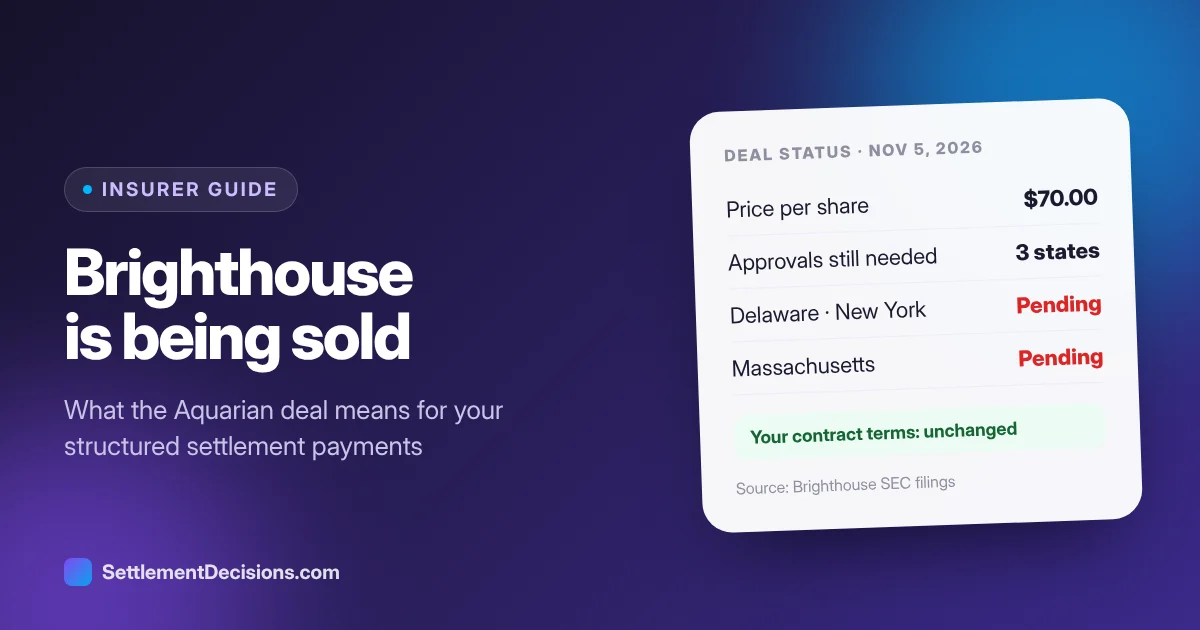
| Nov. 6, 2025 | Brighthouse and Aquarian Capital announce that an Aquarian affiliate will buy Brighthouse Financial for $70.00 a share in cash, a deal valued at about $4.1 billion. Brighthouse says it will keep its name, brand and Charlotte, N.C. headquarters. |
| Sept. 6, 2026 | The merger agreement's deadline is automatically extended to December 6, 2026. |
| Nov. 5, 2026 | Brighthouse reports that every condition is met or waived except insurance regulatory approvals in Delaware, New York and Massachusetts. It says those approvals aren't expected in time for the December 6 deadline, and the parties are discussing an extension. |
Those three states match the three insurers' home states. Each regulator has to sign off on the new owner before the deal can close.
Will the sale change your payments?
No. Aquarian is buying the parent holding company. The insurance companies that owe annuity payments stay in place, under the same names.
Brighthouse's 2026 disclosure notice to contract owners puts it plainly. After the deal, Aquarian becomes the ultimate parent, and Brighthouse Life Insurance Company remains a subsidiary. The notice says the company "will continue in its present role as the issuer of your Contract," and that your rights and benefits, and the company's obligations, "will remain unchanged."
For a structured settlement, that means:
- Same amounts, same dates. The schedule in your settlement agreement is fixed. A change of owner can't rewrite it.
- Same legal parties. The issuer (the insurer that holds the annuity) and the obligor (the company that owes you) don't change because a parent company was sold.
- No action needed. Nobody needs your signature for the merger. Be wary of anyone who calls about the Brighthouse sale and says you need to act, sign or sell.
Is your structured settlement with Brighthouse or MetLife?
Many structured settlement payees see both names, because of the 2017 split. A Brooklyn court record shows the setup: in a February 2021 transfer case, the annuity issuer was Brighthouse Life Insurance Company and the obligor was Metropolitan Life Insurance Company (Kings County, 2021).
Check your settlement agreement and your payment statements for two names:
| Role | Where to find it | Example from the 2021 case |
|---|---|---|
| Issuer (holds the annuity) | Annuity contract, payment statements | Brighthouse Life Insurance Company |
| Obligor / assignee (owes the payments) | Settlement agreement, qualified assignment | Metropolitan Life Insurance Company |
If MetLife is the obligor or sends your payments, MetLife's structured settlement service line is 1-800-638-2704 (Monday to Friday, 8 a.m. to 9 p.m. ET). Our MetLife structured settlement guide covers MetLife's side in detail. If your statements come from Brighthouse, use the phone number printed on them. Our guide to owner, payee and beneficiary roles explains who controls what.
Is Brighthouse financially safe?
Here's what the filings show. They're snapshots, not guarantees.
| Measure | What Brighthouse reported |
|---|---|
| Combined risk-based capital (RBC) ratio | 415% to 435% (preliminary estimate, Sept. 30, 2026) |
| Statutory combined total adjusted capital | $4.8 billion (Sept. 30, 2026) |
| A.M. Best outlook | Revised to negative from stable in January 2025 (per Brighthouse's 2024 annual report) |
A risk-based capital ratio compares an insurer's capital with the minimum regulators require for its risks. Brighthouse's own notice also reminds owners that its guarantees depend on its claims-paying ability. Check A.M. Best for the current rating, since a rating can change after the deal closes.
If any life insurer ever fails, your state's life and health insurance guaranty association steps in up to set limits. In most states the limit for annuity benefits, including structured settlement annuities, is $250,000 in present value per person. Coverage follows the payee's state of residence. See what happens if your insurer goes bankrupt.
Should you sell because of the sale?
Not because of the merger. The deal doesn't make your payments worth less, and selling locks in a buyer's discount. Sell only if you have a real need for cash that cheaper options can't cover.
If you do sell, a judge has to approve the deal under your state's structured settlement protection act. A buyer that skips court owes a 40% federal excise tax (26 U.S.C. § 5891), so legitimate buyers always go to court. The issuer and obligor get notice and redirect the sold payments after approval.
The 2021 Brooklyn case shows how much timing matters. The payee sold 96 life-contingent monthly payments that wouldn't start until 2046 and ran to 2054, worth $641,822.88 in total. The court approved a net price of $10,100, about 1.6% of the payments' face value. Payments decades away, and payments that stop if the payee dies, sell for very little. Compare your own offer with approved deals in the court deal benchmark.
What to do now
- Do nothing about the merger. Keep your settlement agreement and statements somewhere safe.
- Confirm your issuer and obligor. Write both names down from your paperwork.
- Keep your address current with whichever company sends your payments, so letters about the deal reach you.
- Ignore pressure tied to the sale. A call saying you must sell before Aquarian takes over is a sales pitch, not a requirement.
- If you need cash, sell only what you need. A partial sale usually costs less than selling everything. Get at least three written offers and check each one with the discount rate calculator.
- Talk to a qualified financial advisor before you sign anything.