

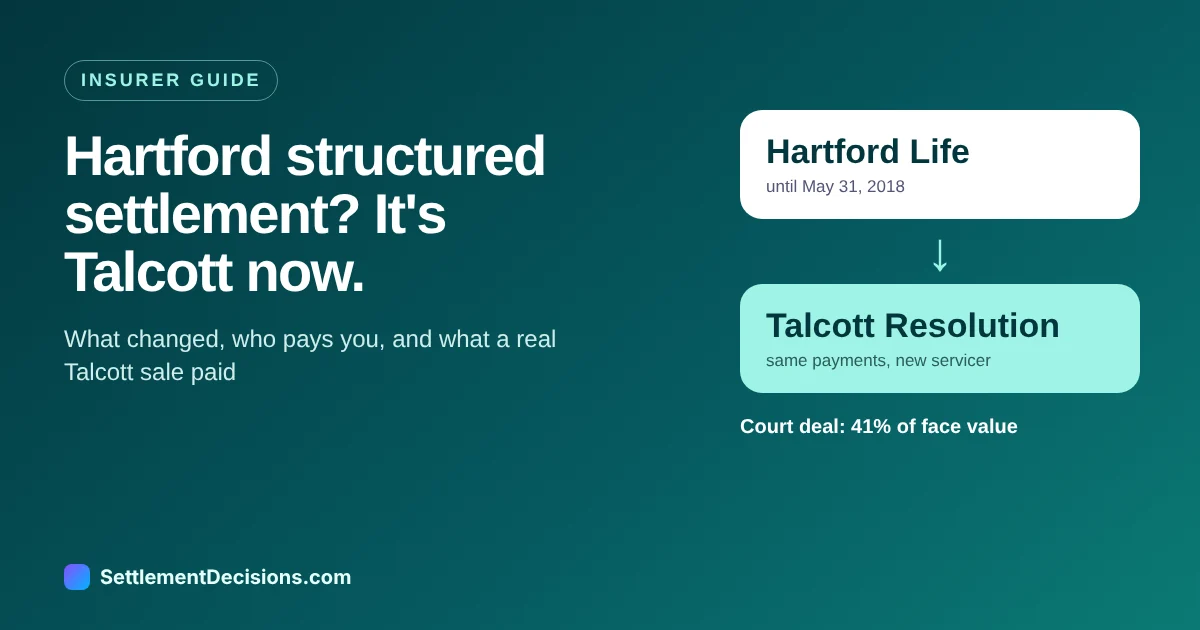
Why your Hartford payments now say Talcott
The Hartford sold its life insurance and annuity business years ago. Its May 31, 2018 news release says it "completed the sale of Talcott Resolution, its run-off life and annuity businesses" to an investor group led by Cornell Capital, Atlas Merchant Capital, TRB Advisors, Global Atlantic, Pine Brook and J. Safra Group. Total consideration to The Hartford was about $2.05 billion.
The company that used to issue Hartford annuities now files with the SEC as Talcott Resolution Life Insurance Company. If your settlement documents say "Hartford Life," Talcott is who pays you today.
What changed for you: the company name, the website and possibly the mailing address. What didn't change: your payment amounts, dates and contract terms. A sale of the company doesn't rewrite your settlement.
Who owes your payments now
A 2021 Brooklyn court order on a Talcott payee shows the current structure:
| Role | Company |
|---|---|
| Obligor (owes you the payments) | Talcott Resolution Comprehensive Employee Benefit Service Company ("CEBSCO") |
| Annuity issuer | Talcott Resolution Life Insurance Company |
Your own contract may name a different Hartford-era company, so check the qualified assignment and the annuity contract.
How to contact Talcott
Talcott's contact page says that if you're a Talcott Resolution or Union Security annuity customer with a purchase date before 2024, you should use the Annuity Service Center to log in, manage your account, access forms and find annuity resources. A structured settlement annuity set up under Hartford falls in that group. The company now calls itself Talcott Financial Group.
Use the service center or the phone number on your payment letter to:
- Request a letter listing your remaining payments (see income verification letters).
- Update your address or direct deposit, especially if your mail still goes to an old Hartford address.
- Check your beneficiary designation. See change your beneficiary.
Watch out: a company change is a common opening for confusing calls. If someone says they're "from Hartford" or "Talcott" and offers to cash out your payments, hang up and call the number on your own statement. Insurers don't buy payments; factoring companies do.
What a real Talcott sale paid
From Park St Closing, LLC v Talcott Resolution, Kings County Supreme Court, February 25, 2021:
| Item | Detail |
|---|---|
| Payments sold | $10,000 (Oct. 2021), $20,000 (Oct. 2025) and $35,159.66 (Oct. 2030): $65,159.66 in total |
| Gross price | $26,605, less any prior advances and permitted deductions |
| Share of face value | about 41% |
| Implied annual rate | about 16.8% (our calculation, on the gross price at the order date) |
| Talcott's fee | $1,500 processing fee, paid by the buyer, not charged to the payee |
| Result | Approved without opposition |
About 16.8% sits at the top of the range in our court deal benchmark, where approved New York deals run from about 7% to 16%. Approved doesn't mean cheap: the judge found it acceptable, but competing offers could likely have done better.
If you're considering a sale
- Confirm your schedule with Talcott in writing first.
- Get at least three written offers for the same payments and compare net cash and the effective rate with our discount rate calculator.
- Sell only what you need. Selling far-off lump sums costs the most per dollar. See partial sales.
- Check the buyer's registration where required: registered buyers by state.
- Prepare for the hearing. See the court approval process.
Talk to a qualified financial advisor who doesn't profit from the sale before you sign.