

The short answer
J.G. Wentworth prices every deal individually. The two numbers that matter are:
- Share of face value: the cash you receive divided by the total of the payments you sell.
- Effective annual rate: the yearly rate at which your payments are worth exactly the cash you're paid, after all fees.
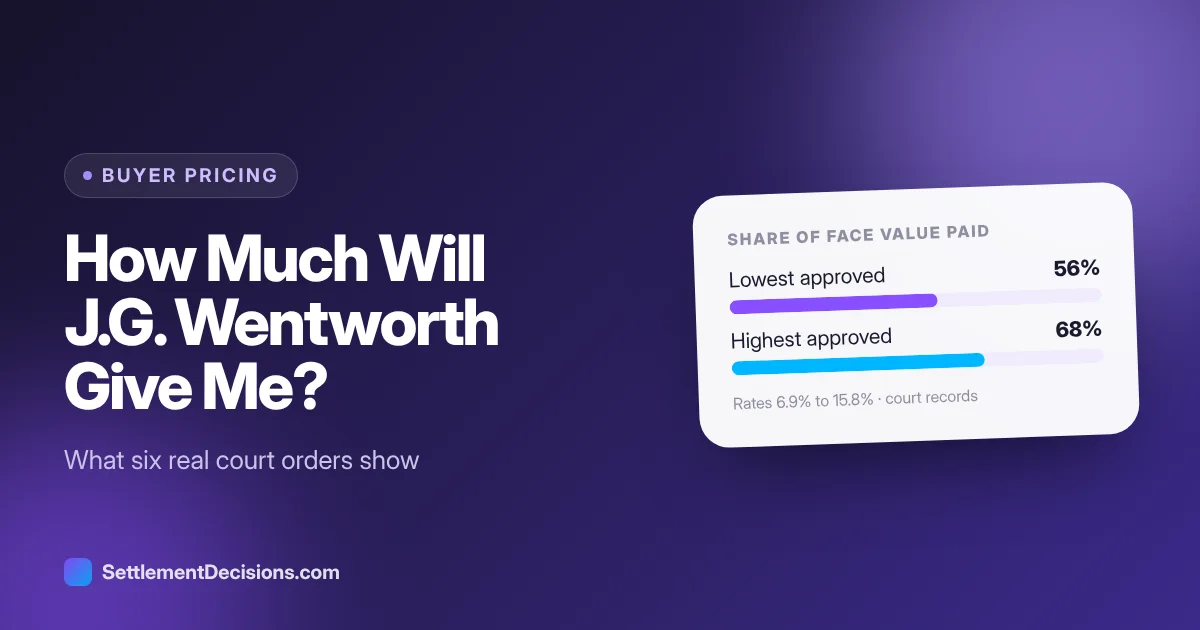
In published New York court orders, J.G. Wentworth's approved deals landed between about 56% and 68% of face value, at effective rates from about 6.9% to 15.8%. Where your deal lands depends mostly on how far in the future your payments are, how big they are, and whether another buyer is bidding.
Six real J.G. Wentworth deals
Every figure below comes from the linked court order. Rates marked "court" were stated in the decision; the others are implied by the payments sold and the net cash paid, valued at the order date.
| Order | Insurer | Payments sold (face value) | Cash to seller | Share of face | Rate | Result |
|---|---|---|---|---|---|---|
| Kings Co., Mar. 3, 2021 | Allstate Life of NY | $35,000 (2025) + $25,000 (2030): $60,000 | $40,000 | 67% | ~6.9% | Approved |
| Kings Co., Apr. 23, 2021 | Pacific Life & Annuity | Monthly payments in 2021 and 2026–2032: $80,102 | $45,000 | 56% | ~8.3% | Approved |
| Kings Co., Dec. 9, 2021 | Fidelity & Guaranty Life | One lump sum due 2026: $142,151 | $97,000 | 68% | ~9.4% | Approved |
| NY Co., Mar. 12, 2015 | MetLife | 84 monthly payments, 2015–2022: $82,792 | $55,000 (raised from $48,000) | 66% | 10.3% court (was 14.33%) | Approved |
| Kings Co., Mar. 23, 2021 | Allstate Life of NY | $746.22 a month, 2021–2026: $45,519 | not printed | – | 11.06% court | Approved |
| Kings Co., Dec. 9, 2021 | New York Life | $319.09 of each monthly payment, 2021–2028: $26,804 | $17,246 | 64% | ~15.8% | Approved |
And one it lost:
| Order | Insurer | Payments sold | Offer | Share of face | Result |
|---|---|---|---|---|---|
| Warren Co., Oct. 26, 2021 | John Hancock (interested party) | 156 monthly payments, 2035–2048: $228,886 | $97,500 | 43% | Denied: the seller's 14 prior sales had returned about 23 cents per dollar |
Why the percentage changes so much
The share of face value is mostly a function of time. Money due in 20 years is worth much less today than money due next year, so the same rate produces very different percentages.
Here's what a buyer would pay per $100 of payments at three rates. This is plain math, not a quote:
| Payment timing | At 7% | At 9% (court median) | At 12% |
|---|---|---|---|
| Lump sum in 1 year | $93 | $92 | $89 |
| Lump sum in 5 years | $71 | $65 | $57 |
| Lump sum in 10 years | $51 | $42 | $32 |
| Lump sum in 20 years | $26 | $18 | $10 |
| Monthly payments for 5 years | $85 | $81 | $76 |
| Monthly payments for 10 years | $72 | $67 | $60 |
| Monthly payments for 20 years | $55 | $47 | $39 |
The 9% column uses the median rate across the 13 approved, guaranteed-payment deals in our court-record dataset.
That's why "J.G. Wentworth gives 60%" can be true for one person and false for the next. Ask about the rate, then use the share of face value to sanity-check it.
Other factors that move your number:
- Life-contingent payments, which stop at death, are priced much lower. See life-contingent payments.
- Deal size. Small deals carry fixed legal and court costs, which push the effective rate up. The 15.8% deal above was the smallest.
- Repeat sales. The New York Life seller in the 15.8% deal had already sold four slices of the same payment stream to J.G. Wentworth since 2014.
- Competition. The only thing you fully control.
How to get more from J.G. Wentworth
- Know your schedule exactly. Get a letter from your insurer listing every remaining payment.
- Get the rate in writing. Ask J.G. Wentworth for the effective annual discount rate as well as the cash amount.
- Get two independent quotes. Peachtree and Stone Street are J.G. Wentworth brands, so a quote from them isn't real competition. Ask buyers outside that group.
- Compare net cash on the disclosure statement, after all fees, for the same payments.
- Run any offer through our court deal benchmark to see where it sits against real court-approved deals.
- Remember the judge is on your side. In the 2015 MetLife case the court approved the deal only after J.G. Wentworth raised its offer by $7,000.
Before you accept any offer, talk with a financial advisor who doesn't earn anything from the sale.
About J.G. Wentworth
J.G. Wentworth was founded in 1991 and is based in Chesterbrook, Pennsylvania. Its parent company went through Chapter 11 bankruptcy in 2009 and again in 2017. Its main brands are J.G. Wentworth, Peachtree and Stone Street. For its fees, complaint history and alternatives, read our J.G. Wentworth review and the comparison of J.G. Wentworth, DRB Capital and SenecaOne.