

Who is Stone Street Capital?
Stone Street Capital is a structured settlement and annuity purchasing company headquartered in Bethesda, Maryland. Consumer review sites that profile the company report that it was founded in 1989, which makes it one of the older buyers still active. It describes itself as "direct-funded", meaning it says it pays sellers with its own capital rather than brokering the deal to another buyer.
According to RetirementLiving's profile, the company says it has purchased more than $2.6 billion in structured settlements and other annuities. That figure comes from the company and has not been independently audited, so treat it as a sign of scale rather than a verified number.
In state registration records the buying entity appears as Stone Street Originations, LLC. That name shows up on:
- the Georgia Secretary of State's list of registered structured settlement purchase companies (updated July 1, 2026), where it holds registration number SSPC-00001, and
- the Minnesota Secretary of State's active list of structured settlement purchasing companies.
If a contract or court petition names Stone Street Originations, LLC, that is the same business. You can see how registration works state by state in our guide to registered structured settlement buyers.
What Stone Street buys
Like most buyers, Stone Street offers a lump sum in exchange for some or all of your future payments. It buys:
- Guaranteed structured settlement payments from personal injury, wrongful death and similar cases.
- Life-contingent payments, which stop when the payee dies. These are harder to price, and buyers usually require life insurance or charge a higher discount rate. See life-contingent payments explained.
- Annuity payments that are not tied to a lawsuit.
- Partial sales, such as the next five years of payments or a fixed dollar amount, leaving the rest of the stream to you.
Every sale of structured settlement payments from a court case has to be approved by a judge under your state's structured settlement protection act. If it isn't, the buyer owes a 40% federal excise tax on the discount under 26 U.S.C. § 5891. That is why no legitimate buyer, Stone Street included, will complete a transfer without a court order.
Rates and fees: what the public record shows
Stone Street does not publish a rate card. Third-party reviews report discount rates in a wide band. RetirementLiving lists roughly 6% to 20%, which is typical for the industry and tells you little on its own. The more useful evidence is in court decisions, because judges have to put the actual numbers on the record.
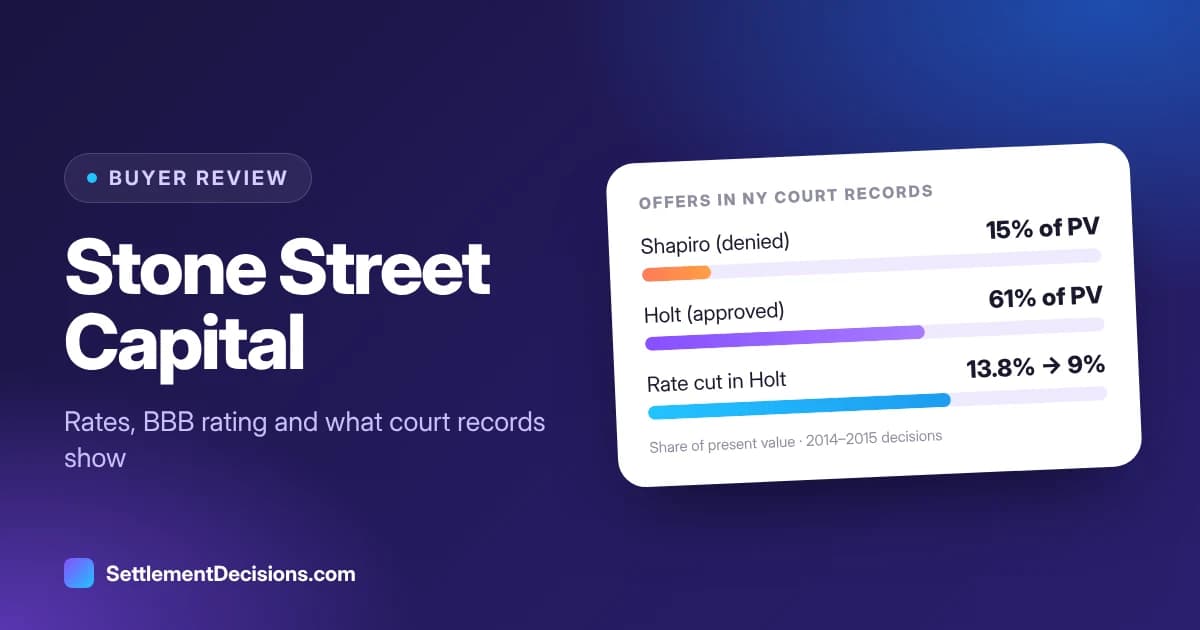
Two New York decisions involving Stone Street show how far apart offers can be.
| Case | Payments sold | Price | Share of present value | Result |
|---|---|---|---|---|
| Matter of Stone St. Capital LLC v Shapiro (Suffolk County, Feb. 27, 2015) | 240 life-contingent monthly payments of $1,053.42, 2017 to 2037 ($252,823.20 total) | $32,000 | About 15% of $211,333.60 | Denied: not in the payee's best interest |
| Matter of Stone St. Capital LLC v Holt (New York County, Aug. 28, 2014) | Payments with a face value of $30,293 | $16,371 (raised from $12,586) | About 61% of $26,718.88 | Approved after the price was raised; implied discount rate cut from 13.79% to 9.00% |
Two points stand out.
First, the price moved. In Holt, the original offer was $12,586. By the time the court approved the deal, the price had risen to $16,371 and the implied discount rate had fallen from 13.79% to 9.00%. That is a 30% increase in cash for the seller on the same payments. Offers are negotiable, and a hearing is a real checkpoint.
Second, judges do say no. In Shapiro, the judge wrote that $32,000 for payments with a present value of about $211,000 was not fair to a payee with two young children, even allowing for the fact that the payments were life-contingent. The seller told the court he considered the price unfair but accepted it because of money pressure. Courts see that pattern often, which is why the best-interest test exists.
Neither case tells you what Stone Street would offer you today. They are a decade old and each deal has its own facts. But they show the range a single buyer can produce, and why you should never treat a first quote as final. Run your own numbers in the payout calculator before you talk to any buyer.
Rule of thumb: Ask every buyer for the purchase price, the total of the payments you are selling, and the effective annual discount rate in writing. If a company won't put the rate in writing, assume it is high.
The fabricated court orders at Stone Street's former law firm
Both cases above came to court for an unusual reason. Stone Street had already paid the sellers years earlier, relying on court orders that turned out to be fake.
According to the Holt decision, an approval order dated August 16, 2011 and bearing a judge's signature was fabricated by a "rogue" paralegal at the law firm Stone Street had hired to handle its New York petitions. In Shapiro, the court found that an order dated March 7, 2013 had been fabricated by an employee of the same former counsel, who had also fabricated pleadings and orders in other transactions. Stone Street learned of the problem in October 2013.
In July 2015, Insurance Journal reported that Stone Street had sued the firm, Paris & Chaikin PLLC, its two partners and a paralegal. Stone Street alleged that the firm supplied 76 falsified court orders out of more than 100 files sent between 2009 and 2013, and that insurers stopped paying on the affected transfers once the problem came to light. Those were allegations in Stone Street's complaint; the defendants did not comment to the publication.
What does this mean for a seller today?
- The fraud was committed against Stone Street, not by it, according to the courts and the company's own lawsuit. Stone Street went back to court to get valid approvals.
- It still affected sellers. Some people had their deals reopened years later, and in Shapiro's case the court refused to approve the transfer at all.
- The lesson is general. Ask for the case number of your approval hearing, and confirm the signed order with the court clerk yourself. A real order is a public court record.
BBB rating and customer reviews
Profiles of the company on RetirementLiving and TopConsumerReviews report that Stone Street holds an A+ rating from the Better Business Bureau and has been BBB-accredited for many years, with RetirementLiving citing accreditation since 1996. Ratings can change, so check the live BBB profile before you sign.
Keep in mind what a BBB rating measures. It reflects how a business responds to complaints and how long it has operated, not whether its prices are good. An A+ buyer can still make a low offer. Our BBB ratings guide for structured settlement companies explains how to read a profile.
Common themes in public reviews:
- Positive: experienced representatives, a clear explanation of the court process, and money paid as promised once the order was signed.
- Negative: frequent phone calls and mail after a first contact, and discomfort that the company found the person through public court records. Those records are public, and many buyers use them.
RetirementLiving reports funding in about 45 to 60 days, which is typical. Most of that time is the court calendar, not the buyer.
How to compare a Stone Street quote
Use the same checklist with every buyer:
- Get the offer in writing, with the price, the exact payments being sold, and the discount rate.
- Ask about every deduction. Some buyers net legal fees or processing charges out of the price. You want the amount that will actually reach your bank account.
- Get at least two competing quotes. Our instant offer estimator shows the range, and the companies directory lists other buyers.
- Check the court record. Your state's protection act requires a written disclosure statement and, in many states, advice from an independent professional. See the court approval process.
- Sell only what you need. A partial sale keeps more of your future income.
- Watch for advance offers. A cash advance before the hearing can make it harder to walk away. Read cash advances before court approval first.
Questions to ask Stone Street before you sign
Whether you call Stone Street or it calls you, these questions get you the information a judge will look at anyway:
- Which entity is buying my payments? Expect Stone Street Originations, LLC, and check it against your state's registration list.
- Exactly which payments are you buying? Get dates and amounts, not just "the next 10 years".
- What is the effective annual discount rate? Your state's disclosure statement must show it. Ask for it before the formal paperwork.
- What will I actually receive? Ask whether any fees, legal costs or prior advances come out of the price.
- Is any part of my payments life-contingent? If so, ask whether life insurance is required and who pays for it.
- Where and when will the petition be filed? Write down the county and, once filed, the case number.
- Will you send me the signed court order? Then confirm it with the clerk yourself.
If you already have a written offer from another buyer, say so. The Holt case shows that a better price is often available when a seller, or a judge, pushes for one.
Our verdict
Stone Street Capital is a real, long-established buyer that is registered where states require it and holds a strong BBB profile. Its own court history shows that the price on the table can be far below what is fair, and also that it can move when a court pushes back.
That makes it a reasonable company to get a quote from, and a poor company to get your only quote from. The same is true of every buyer. Compare at least three written offers, compare the discount rates, and talk to a financial advisor who has nothing to gain from the sale before your hearing.