

Who owes your Berkshire Hathaway payments?
A Berkshire structured settlement usually involves three Berkshire companies. A 2019 BHGSS brochure explains the setup:
| Role | Company |
|---|---|
| Assignment company (legally owes you the payments) | BHG Structured Settlements, Inc. (BHGSS), a Missouri company |
| Annuity issuer (funds the payments) | Berkshire Hathaway Life Insurance Company of Nebraska (BHLN), in every state except New York |
| Issuer in New York | First Berkshire Hathaway Life Insurance Company (FBHL), owned by BHLN |
| Guarantor of BHGSS on assigned cases | Columbia Insurance Company, BHGSS's parent |
When your case settled, the defendant or its insurer handed its payment obligation to BHGSS. BHGSS then bought an annuity from BHLN that pays the same schedule. After that assignment, the payments can't be changed.
Your settlement agreement names the exact companies and your contract number. If the terms are unfamiliar, see owner, payee and beneficiary explained.
How to contact Berkshire Hathaway about your payments
BHG Structured Settlements runs bhstructures.com, which has a payee portal, a documents and forms page, and an FAQ. Its listed phone number is (402) 916-3100.
Use the portal or phone for address changes, direct deposit, beneficiary questions and a letter listing your remaining payments. For lenders, see income verification letters.
Berkshire stopped selling new structured settlements. Are your payments safe?
Berkshire's pause applies to new annuities, not existing ones. According to A.M. Best's May 2026 rating release, BHLN suspended new structured settlement business in 2023 while it "awaits more favorable macro-economic conditions," and 2024 was FBHL's second full year with no new sales.
The same release affirmed both insurers' ratings with stable outlooks:
| Insurer | A.M. Best financial strength | Long-term issuer credit |
|---|---|---|
| Berkshire Hathaway Life Insurance Company of Nebraska | A++ (Superior) | aa+ |
| First Berkshire Hathaway Life Insurance Company | A+ (Superior) | aa- |
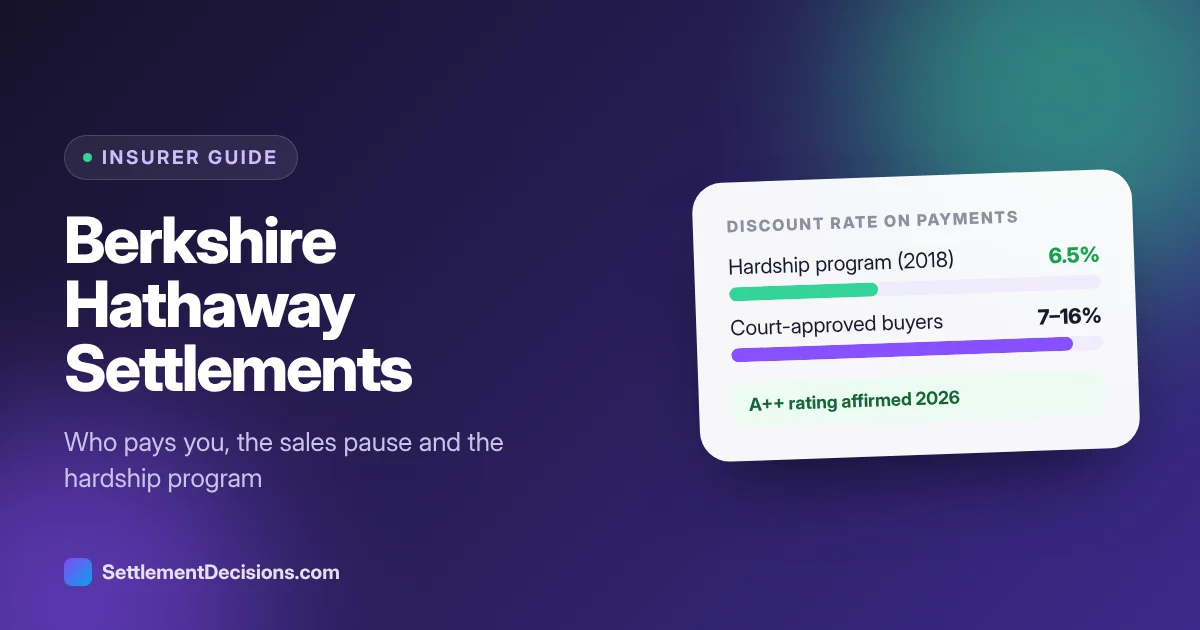
A++ is A.M. Best's highest rating. A pause in new sales doesn't change your contract: the payments you were promised remain owed. For the rare case of an insurer failing, see what happens if a structured settlement insurer goes bankrupt.
Berkshire's hardship exchange program
This is the part most Berkshire payees never hear about. In 2018, structured settlement planner John Darer reported on notices Berkshire was mailing to its payees. The notices warned about payment buyers and described a Hardship Exchange Program:
- Berkshire may buy back some payments itself when a payee has a real hardship. It said it worked with payees to keep the transaction as small as possible.
- It used a 6.5% discount rate at the time. Most third-party buyers charge more; New York court orders we track show approved rates from about 7% to 16%.
- It used a hardship standard, which is stricter than the "best interest" test in most state laws.
- It could split payments, so a payee who still sold part to an outside buyer didn't need a separate servicing company.
- It filed information with courts in outside sales, including earlier sales, and said some buyers raised their offers after it did.
Berkshire said fewer than 1.5% of payees who got a letter called, and it agreed to work with only part of those who applied. We couldn't confirm whether the program runs today on the same terms, so ask BHGSS directly before you talk to any buyer.
Selling Berkshire Hathaway payments to a buyer
You can sell to a third-party buyer, but expect Berkshire to take an active part in court. Every sale needs a judge's approval under your state's protection act, and Berkshire is notified as an interested party.
A 2004 federal case shows how involved Berkshire has been. In Settlement Capital Corp. v. BHG Structured Settlements (N.D. Tex.), a buyer sued after Berkshire wrote to the court opposing a sale as not in the payee's best interest; the payee then dropped the buyer and made a deal with Berkshire. The court let the buyer's claims go forward, reading the Texas law as letting an insurer oppose a transfer but not as an opening to compete on price. That was an early ruling at the motion stage, not a final judgment, but it shows Berkshire has stepped in before.
Smart order of steps:
- Call BHGSS first and ask whether a hardship option exists and what rate it uses.
- Get your remaining-payments letter so you know exactly what you'd sell.
- Get at least three written offers for the same payments and compare net cash and the effective rate with our discount rate calculator.
- Sell only what you need. See partial sales.
- Benchmark the offer against real court-approved deals with the court deal benchmark.
Before you decide, talk to a qualified financial advisor who has nothing to gain from the sale.