
Who is WePayMore Funding?
WePayMore Funding, LLC is a structured settlement purchasing company based in South Florida. It markets itself as "We Pay More Funding" and says it buys:
- future structured settlement payments,
- annuity payments, and
- lottery prize installments,
in exchange for a lump sum. Its 2022 press releases describe offers for "some or all" of a seller's remaining payments, help with the court approval process, and quick payment once a court approves the sale. Those releases listed an office at 16 NE 4th Street in Fort Lauderdale.
The Better Business Bureau profile lists the business address as 1985 N Andrews Avenue in Wilton Manors, Florida, and gives a business start date of January 15, 2019. That makes WePayMore a young company by industry standards. J.G. Wentworth, Peachtree and Stone Street have each been buying payments for decades.
Young doesn't mean bad. It does mean there is less public history to check, which is why the rest of this review focuses on what can be verified.
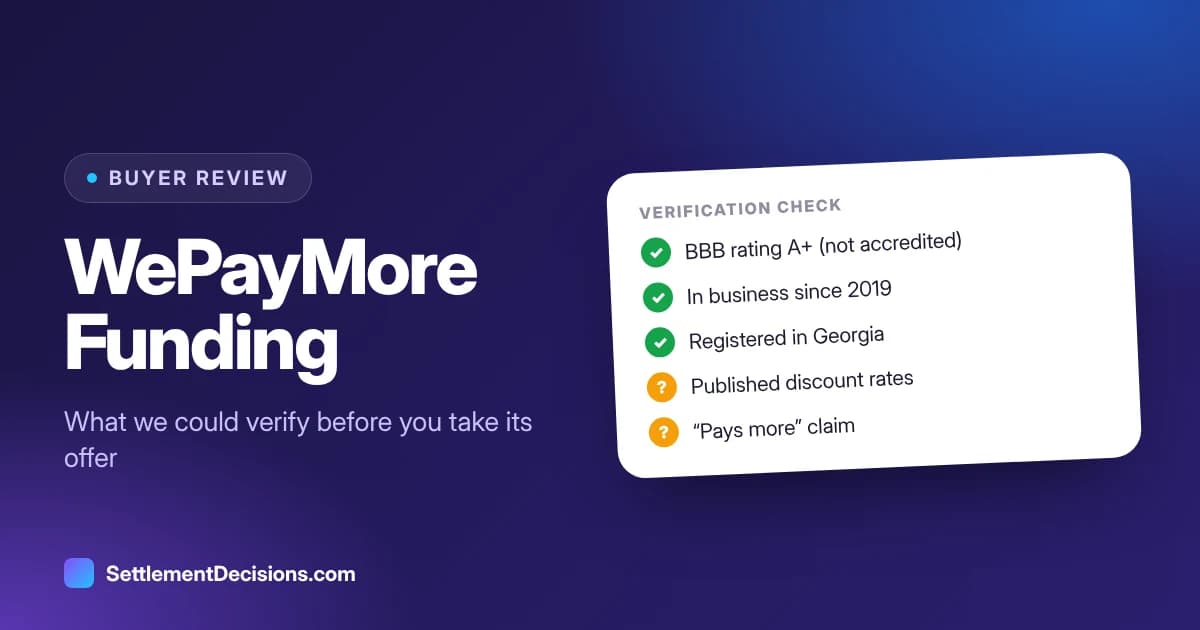
What we could verify, and what we couldn't
| Question | What we found | Source |
|---|---|---|
| Is it a real, registered business? | Yes. WePayMore Funding, LLC has a BBB profile and appears on Georgia's registration list. | BBB; Georgia Secretary of State |
| BBB rating | A+, not BBB-accredited | BBB profile |
| In business since | January 15, 2019 (per BBB) | BBB |
| Registered in Georgia? | Yes. It appears three times on the July 1, 2026 list. | Georgia Secretary of State |
| Registered in Minnesota? | Not on the active list we checked | Minnesota Secretary of State |
| Published discount rates | None found | — |
| Court decisions on its deals | None found in published opinions | Court reporter searches |
| "Pays more" than competitors | Not independently verified | Company marketing |
The "pays more" idea is in the company's name and its marketing. We found no independent data, such as published court approvals or mystery-shopping results, that show its offers beat other buyers on average. That doesn't mean they don't; it means you can only find out by comparing written quotes on your own payments.
BBB rating: what A+ without accreditation means
The BBB gives WePayMore an A+. The BBB's letter grade reflects factors such as complaint history, how complaints were answered, time in business and transparency. Accreditation is separate. It is a paid program in which a business agrees to BBB standards. Many good companies are not accredited, and some accredited companies still make poor offers.
What the rating can't tell you is whether a specific offer is fair. That depends on the discount rate, the payments you're selling and the fees. Our BBB ratings guide explains how to read a profile, including the complaints tab, which is often more useful than the letter grade.
State registration: why it matters
Several states require structured settlement buyers to register with a state office and post a bond before they can file transfer petitions. Georgia publishes its list of registered purchase companies, and WePayMore appears on it. Minnesota requires registration with the Secretary of State and publishes an active list. WePayMore wasn't on the version we checked.
If you live in a state that requires registration, ask any buyer for its registration number and check it yourself. Our guide to registered structured settlement buyers by state lists the rules and where to find each state's list.
What a WePayMore deal should look like
The process should match every other legitimate buyer, because state law sets the steps:
- Quote. You share your settlement details and get an offer. Ask for it in writing, with the exact payments being bought.
- Contract and disclosure. Your state's protection act requires a written disclosure statement showing the total of the payments, the price, the discounted present value and the effective discount rate. Read it before you sign.
- Independent advice. Many states require, or strongly expect, that you get advice from a professional who isn't paid by the buyer. See independent professional advice.
- Court petition and hearing. The buyer files in court, and a judge decides whether the sale is in your best interest. Learn what happens in our court approval guide.
- Funding. After the order is signed and the annuity issuer acknowledges the transfer, you're paid.
If any buyer suggests skipping the court step, stop. A transfer of court-case structured settlement payments without a qualified order exposes the buyer to a 40% federal excise tax under 26 U.S.C. § 5891, and it leaves you without the protection the law is meant to give you.
How to test the "we pay more" claim
The only way to know whether WePayMore pays more on your payments is to compare. Here's a simple test:
- Get three written offers for the same payments: WePayMore plus two others. Our instant offer estimator and the companies directory help you find comparison buyers.
- Line up the discount rates. The disclosure statement must show the effective annual rate. Lower is better for you.
- Compare net cash. Ask each buyer what will actually land in your account after any fees.
- Check your baseline. The payout calculator shows what your payments are worth at different rates.
For scale: $1,500 a month for 10 years ($180,000 in total) is worth about $118,400 at 9%, $104,600 at 12% and $93,000 at 15%. These are illustrations, not offers. A three-point difference in the discount rate on that stream is worth roughly $12,000 to $14,000 to you.
Rule of thumb: A buyer that really pays more will be happy to put its discount rate in writing next to a competitor's. If a company pushes you to sign before you compare, slow down.
Watch for advances and loan offers
Some listings for the company describe help with borrowing against a structured settlement as well as selling. Be careful with any money paid before the court hearing. An advance can make it harder to walk away if a better offer appears, and loans secured by settlement payments raise their own legal questions. Read structured settlement loan vs. selling and advances before court approval before accepting anything early.
How WePayMore compares with established buyers
Here's how WePayMore stacks up on the facts we could check against three long-running buyers. None of this measures price; it measures how much public history you have to go on.
| Buyer | In business | Georgia registration (July 2026) | Minnesota active list | Public court decisions |
|---|---|---|---|---|
| WePayMore Funding | Since 2019 (BBB) | Yes | Not on version checked | None found |
| Stone Street Capital | Since 1989 | Yes (Stone Street Originations) | Yes | Yes, see our review |
| J.G. Wentworth | Decades | Yes (J.G. Wentworth Originations) | Yes | Yes |
| Peachtree | Decades | Yes (Peachtree Settlement Funding) | Yes | Yes |
A longer record lets you see how a buyer behaves when a deal goes wrong or a judge pushes back. With a newer company you're relying more on the paperwork in front of you, so read the contract and disclosure statement closely.
Questions to ask WePayMore before you sign
- Which legal entity is buying, and is it registered in my state?
- What is the effective annual discount rate, and what fees come out of the price?
- Are you buying the payments yourselves, or placing them with another investor? Many buyers resell payment streams after closing. That's normal, but it's worth knowing who will own them.
- Will you advance money before the hearing, and what happens to it if I change my mind?
- In which county will you file, and when?
Get the answers in writing. A buyer confident in its pricing won't mind.
Our verdict
WePayMore Funding is a real, registered, A+ rated buyer with a short track record and little independent data on its pricing. That makes it a reasonable company to include in a comparison, as long as you treat "we pay more" as a claim to test, not a promise. Get its offer in writing, compare the discount rate and net cash with at least two established buyers, check registration in your state, and speak to an independent financial advisor before your court date.