

Which Transamerica company pays you?
A Transamerica structured settlement usually involves two companies. New York's Court of Appeals described the standard setup in Cordero v. Transamerica Annuity Service Corp. (2023):
| Role | Company |
|---|---|
| Obligor (legally owes you the payments after a qualified assignment) | Transamerica Annuity Service Corporation |
| Annuity issuer (funds the payments) | Transamerica Life Insurance Company |
Older contracts may name an earlier Transamerica company, such as Transamerica Occidental Life. Your settlement agreement, the qualified assignment and the annuity contract show the exact names and your contract number. Have them ready before you call anyone. For what each role means, see owner, payee and beneficiary explained.
How to contact Transamerica
Transamerica's contact page lists several annuity service lines with different hours, for example 800-755-5801 (Monday to Friday, 8 a.m. to 8 p.m. ET). The lines are split by product, so start with the phone number printed on your payment letter or annual statement: it reaches the team that services your contract.
Ask for:
- A letter listing your remaining payments. Lenders, landlords and buyers all ask for it. See income verification letters.
- Address, direct deposit or beneficiary changes. Ask which form applies to a structured settlement, because insurers often use different forms than for regular annuities.
Can you sell Transamerica structured settlement payments?
Yes, but only with a judge's approval. Transamerica pays the schedule in your settlement. It won't pay early or buy payments back. To get a lump sum, you sell some or all future payments to a buyer, who asks a court to approve the transfer under your state's protection act. Transamerica gets notice of the hearing.
Without a qualified order the buyer would owe a 40% federal excise tax under 26 U.S.C. § 5891, so legitimate buyers always go to court.
The Cordero case: what it means for you
Cordero v. Transamerica Annuity Service Corp. is the most important court decision involving Transamerica structured settlements. The facts are from the Court of Appeals opinion (April 25, 2023):
| Fact | Detail |
|---|---|
| Original settlement | A 1996 lead-poisoning settlement for a child who was left with permanent cognitive impairment |
| Payments | $3,183.94 a month for 30 years, starting at age 18, funded by Transamerica Life |
| What happened | Starting in 2012, at age 22, he made six transfers in under two years, selling all his payments |
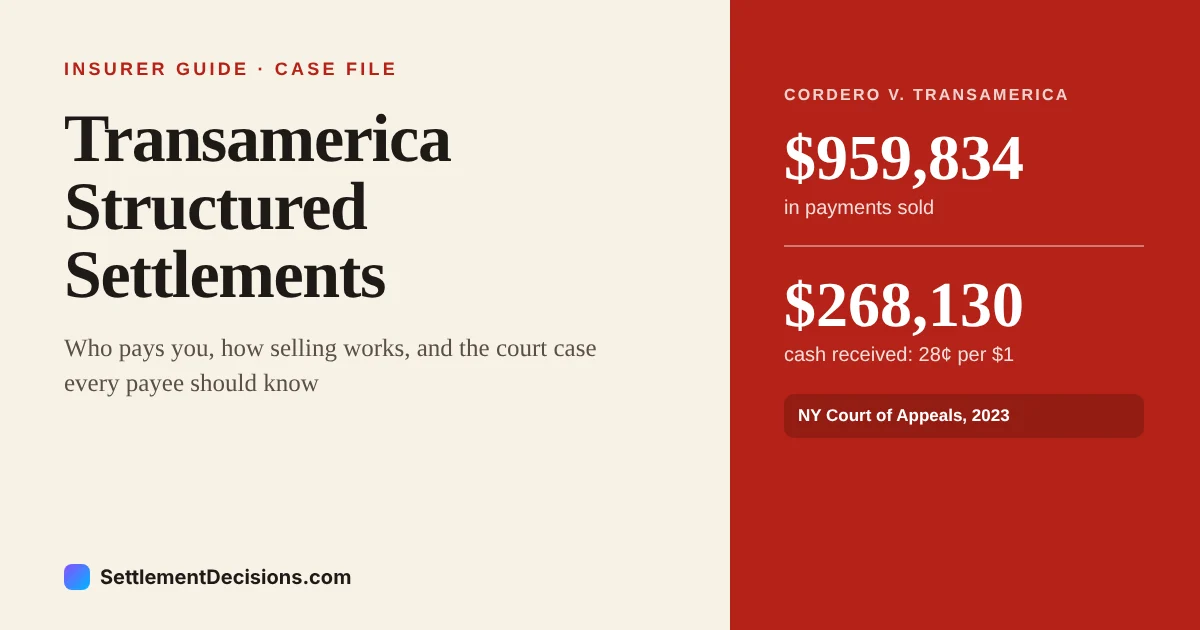
| Total sold | $959,834.42 in payments |
| Cash he received | $268,130, about 28 cents per dollar |
| Court approval | A Florida court approved each transfer. He didn't attend, and no one appeared for him. |
| Transamerica's role | Didn't take part in the hearings. It received a $750 administrative fee per transfer from the buyers. |
He later sued, arguing Transamerica should have objected, since his settlement agreement said he could not "sell, mortgage, encumber or anticipate" the payments. New York's top court disagreed. It held that the insurer had no duty to object, and that under the protection acts "the court, not the issuer or obligor, is tasked with being the gatekeeper." One judge dissented, arguing Transamerica should at least have told the court about his impairment.
The lesson: don't expect the insurer to step in. The judge is your only built-in protection, and a hearing where no one speaks for you protects you very little. If you sell, show up, bring an independent advisor, and know what your payments are worth.
If you're considering a sale
- Get your remaining-payments letter so you know exactly what you'd be selling.
- Sell the smallest piece that solves the problem. See partial sales.
- Get at least three written offers for the same payments, and compare net cash and the effective annual rate with the discount rate calculator.
- Compare the offer with real approved deals in our court deal benchmark. Rates there run from about 7% to 16%.
- Avoid repeat sales. Each new slice tends to be priced worse, as Cordero shows. See can you reverse a sale.
- Attend your hearing and bring someone independent.
Talk to a qualified financial advisor with nothing to gain from the sale before you sign anything.