

The answer depends on two words in your contract
Find your settlement agreement or the annuity contract and look for one of these phrases:
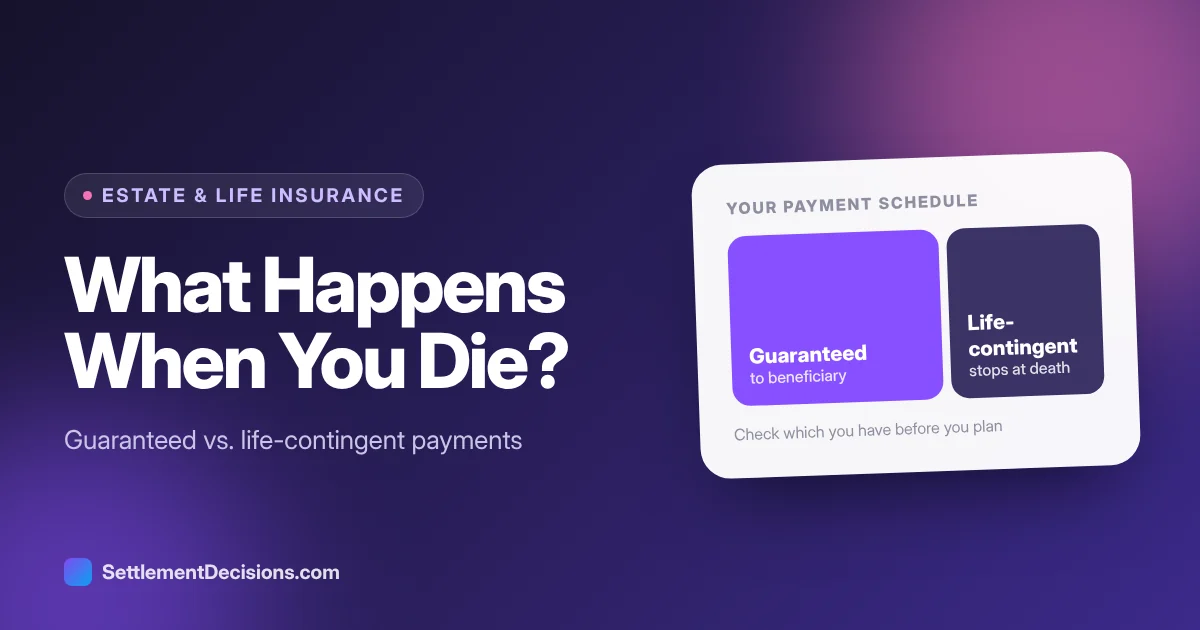
- "Guaranteed" or "period certain". These payments are owed for a fixed number of years whether you're alive or not. If you die early, the remaining guaranteed payments go to your beneficiary.
- "Life-contingent" or "for the life of the payee". These payments continue only while you're alive. They stop at death, and nothing passes to heirs.
Many settlements use both: "life with 20 years certain" pays for as long as you live, but if you die in year 8, your beneficiary receives the remaining 12 years of payments. Lump sums scheduled for specific dates, such as $50,000 in 2030, are usually guaranteed.
If you can't find your documents, our guide to finding lost settlement paperwork explains how to request copies from the annuity issuer.
Who receives the payments
Guaranteed payments go to whoever is named as beneficiary on the annuity. If no one is named, or the named person has already died, they usually go to your estate and pass under your will, or under state law if there's no will.
A few points people often miss:
- The settlement, not your will, often controls. A beneficiary named with the annuity issuer usually takes priority over a will that says something different.
- You may be able to change the beneficiary. Whether you can, and how, depends on your settlement agreement. Some allow a simple form, and others need consent. See how to change a structured settlement beneficiary.
- Minors can't receive payments directly. If you name a child, payments may need to go through a guardian, a custodial account or a trust. An estate planning attorney can set this up.
- Owner, payee and beneficiary are different roles. The assignment company usually owns the annuity, you're the payee, and your beneficiary receives guaranteed payments after you. Our owner, payee and beneficiary guide explains each.
Do structured settlement payments replace life insurance?
Not usually. This is where many families get caught out.
If your payments are life-contingent, the income your family is used to stops the day you die. If a spouse or children depend on that money, there's nothing left to replace it. A term life insurance policy sized to cover the lost income for the years your family would need it is the most common fix. A licensed insurance professional or financial advisor can help you size it.
If your payments are guaranteed, they work a little like life insurance for the guaranteed period. Your beneficiary keeps receiving them. Once the guaranteed period ends, though, there's nothing more to pass on.
A quick way to check your gap:
- Add up the monthly settlement income your household relies on.
- Find how much of it is life-contingent.
- Ask how many years your family would need that amount if you died this year.
That life-contingent amount, multiplied by those years, is a rough measure of the income your family would lose. Life insurance, savings or other planning would need to cover it.
Estate and income tax for your heirs
Estate tax. The value of guaranteed payments still owed at death is generally included in your estate. Under the One Big Beautiful Bill Act, the federal estate tax exemption is $15 million per person in 2026, indexed for inflation after that. Most estates owe no federal estate tax, though some states have their own estate or inheritance taxes with lower thresholds.
Income tax. Payments from a physical injury case are generally tax-free to you under IRC § 104(a)(2). Payments that continue to your beneficiary generally keep that tax-free character. Payments from other kinds of cases can be taxable. Have a tax professional confirm for your settlement.
What changes if you've sold payments
Selling changes who gets paid, permanently.
- Payments you sold belong to the buyer. If you sold 10 years of guaranteed payments and die in year 3, the buyer keeps collecting the remaining 7 years. Your beneficiary receives nothing for that portion.
- Payments you kept still follow your beneficiary designation. This is one reason a partial sale can make sense for people with dependents.
- Life-contingent sales often involve your health. Because the buyer's payments stop if you die, buyers usually ask for medical information. Some may also want to insure your life to protect their investment. Ask each buyer in writing what they require and who would own any policy.
- If you die before court approval, the sale generally doesn't go through, and your payments follow your existing beneficiary designation. Read the agreement for what happens to any advance you received.
Before you sell, ask how the sale would change what your family receives. A judge will consider your dependents when deciding whether the sale is in your best interest.
What if the insurer fails?
If the company paying your annuity becomes insolvent, state life and health insurance guaranty associations protect policyholders, including beneficiaries. According to NOLHGA, structured settlement annuities are usually covered up to $250,000 in present value per payee, typically through the payee's state of residence. Some states provide more. See what happens if the insurance company goes bankrupt.
If you inherit a structured settlement
If you're the beneficiary, contact the annuity issuer with a certified death certificate and proof of your identity. Payments are usually redirected to you once they process the claim. You can keep the payments, or in most states sell them with court approval. See inherited structured settlement options for each path.
Your planning checklist
- Find your annuity contract and mark which payments are guaranteed and which are life-contingent.
- Confirm your beneficiary in writing with the annuity issuer, and keep a copy.
- Make sure your will matches your beneficiary choice, so there are no surprises.
- Plan for minors, through a trust or custodial arrangement.
- Measure the life-contingent gap and talk to a qualified financial advisor or licensed insurance professional about covering it.
- Leave a one-page letter listing the annuity issuer, contract number and contact details, so your family knows where to call.
- Before any sale, get the buyer's answer in writing on how the sale changes what your heirs receive.