

Who owes your Genworth payments?
Genworth was once part of GE, and many of its structured settlements still carry GE names. In recent New York cases the parties were:
| Role | Company |
|---|---|
| Obligor (owes you the payments) | GE Capital Assignment Corporation (GE Capital Assignment Corporation of New York in New York cases) |
| Annuity issuer | Genworth Life Insurance Company of New York, or another Genworth life company outside New York |
Your settlement agreement and annuity contract name the exact companies and your contract number. If "GE Capital" on your paperwork confuses you, that's normal for older Genworth structures. See owner, payee and beneficiary explained.
How to contact Genworth
From Genworth's customer service page and annuity forms page:
| What you need | How |
|---|---|
| General questions | 888-436-9678, Monday to Thursday 8:30 a.m. to 6 p.m. ET, Friday 9 a.m. to 6 p.m. ET |
| Immediate annuity line | 888-322-4629; mail to P.O. Box 2000, Lynchburg, VA 24506 |
| Address change | "Address change form for Structured Settlements or Terminal Funding/Pensions" |
| Beneficiary change | "Beneficiary change request form - Structured Settlements" |
| Direct deposit | Electronic funds transfer (EFT) authorization for annuity payments |
Use the right form. Genworth's general "Annuity contract change form" says "Do not use for Structured Settlements." A wrong form slows everything down.
For a lender or landlord, ask for a letter listing your remaining payments. See income verification letters.
Can you sell Genworth structured settlement payments?
Yes, but only with a judge's approval, and judges look hard at the price. Genworth won't cash out your payments. A buyer files a petition under your state's protection act, Genworth and the assignment company are notified, and the court decides whether the deal is fair and in your best interest. Without a qualified order, the buyer owes a 40% federal excise tax under 26 U.S.C. § 5891.
Two Genworth sales New York courts rejected
| Case | Payments | Offer | Why it failed |
|---|---|---|---|
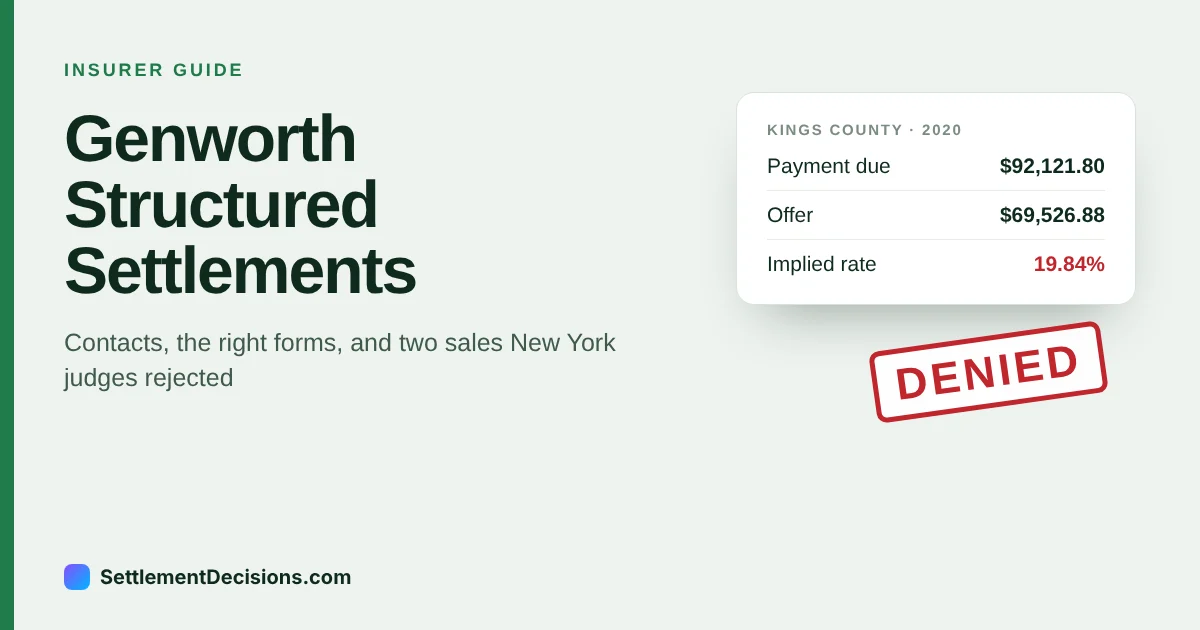
| J.G. Wentworth v Genworth Life Ins. Co. of N.Y., Kings County, July 21, 2020 | One payment of $92,121.80 due October 2021 | $69,526.88 | The implied rate was 19.84% a year for a payment just 15 months away. Present value at the 1.80% federal rate was $89,601.67. Denied as not fair and reasonable. |
| Structured Advisors v GE Capital Assignment, Westchester County, Feb. 5, 2025 | Monthly payments from 2041 to 2053: $291,564 in total | $21,622.04 | Paid 25.14% and 13.09% of present value on the two parts. No documented need, advice waived, earlier sales in 2016. Denied. |
What these teach:
- A short-dated payment should sell for close to its value. Paying 19.84% a year on a payment due in 15 months is expensive, and the judge said so.
- Far-off and life-contingent payments sell cheaply. Payments starting in 2041 brought pennies on the dollar.
- Judges want proof of need. Bills, documents and independent advice all matter.
See how any offer compares with approved deals in our court deal benchmark, and read why courts deny transfers.
If you're considering a sale
- Get your remaining-payments letter from Genworth first.
- Get at least three written offers for the same payments. Use the discount rate calculator to compare them.
- Sell only what you need. See partial sales.
- Bring documents that show your need to the hearing.
- Get independent advice, and don't waive it.
Talk to a qualified financial advisor who has nothing to gain from the sale before you sign.