

What was Imperial Structured Settlements?
Imperial Structured Settlements was the payment-purchasing business of Imperial Holdings, Inc., a specialty finance company headquartered at 701 Park of Commerce Boulevard in Boca Raton, Florida. Imperial Holdings went public on the New York Stock Exchange in 2011 under the ticker IFT.
The company ran two main lines of business:
- Structured settlements. Like J.G. Wentworth or Peachtree, Imperial bought future structured settlement and annuity payments from people who wanted a lump sum now. Those deals went through state court approval under each state's structured settlement protection act.
- Life insurance finance. Imperial also financed and bought life insurance policies. This was the part of the business that drew federal attention.
During its active years the structured settlement unit advertised heavily, ran direct mail campaigns and hired sales staff, as trade press releases from the period show. For many sellers in the late 2000s and early 2010s, "Imperial" was one of the names that called after their settlement became public record.
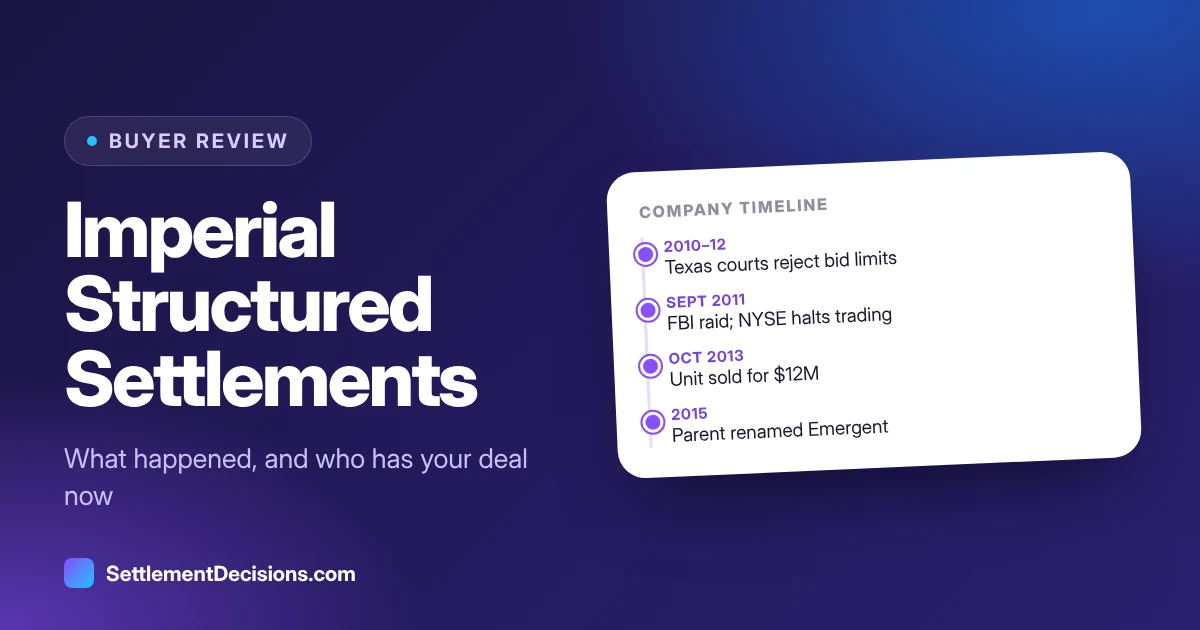
Timeline: from the FBI raid to the sale
| Date | Event | Source |
|---|---|---|
| 2010 to 2012 | Imperial argues in several Texas courts that competing buyers should not be able to bid for payments it had signed up. Courts reject the argument. | Structured Settlement Institute release, May 2012 (competitor-aligned) |
| Sept. 27, 2011 | FBI agents raid Imperial's Boca Raton offices. The investigation relates to its life insurance business. NYSE halts trading. | Insurance Journal, Sept. 28, 2011 |
| Sept. 28, 2011 | Shares fall as much as 75%, to $1.55, in morning trading. | Insurance Journal |
| Oct. 25, 2013 | Imperial closes the sale of its structured settlements business to an entity managed by Blackstone Tactical Opportunities for $12 million. | Imperial Holdings 8-K, Ex. 99.1 |
| Oct. 28, 2013 | Imperial announces the sale. The release says the existing team will keep running the platform under new management. | Same 8-K |
| 2015 | Imperial Holdings changes its name to Emergent Capital. | Company announcement |
Two things are worth separating. The raid concerned the life insurance side, not the structured settlement purchases. And the sale moved the structured settlement unit out of Imperial entirely. From late 2013 on, the business that had been Imperial Structured Settlements belonged to a different owner.
What the Texas court fights tell you
Between 2010 and 2012, Imperial pressed an argument in Texas courts that, once a seller had signed up with it, competing buyers should be blocked from making counteroffers. A Harris County judge rejected that position in April 2012, saying in effect that anyone could bid on structured settlement payments. The account comes from a press release by the Structured Settlement Institute, which quoted executives at a competing buyer, so it reflects one side. Imperial's arguments are not presented in it.
The underlying point still matters to sellers today. Until a court approves your transfer, you can usually still compare other offers. Some contracts include exclusivity or right-of-first-refusal language, and some buyers advance money before the hearing to lock you in. Read our guide to cash advances before court approval before you accept money early, and ask a lawyer what your contract actually says.
Is Imperial Structured Settlements still in business?
Not as Imperial. Based on Imperial Holdings' own SEC filing, the structured settlement unit was sold in October 2013, and the parent later renamed itself Emergent Capital. We could not find a current state buyer registration under the Imperial Structured Settlements name on the lists we checked, including Georgia's July 2026 list of registered purchase companies and Minnesota's active list.
That leaves three situations a seller might be in:
- You sold payments to Imperial years ago. Your transfer was approved by a court at the time, and the payments now go to whoever owns that payment stream. Ownership of purchased payment streams often changes as buyers sell portfolios to investors. Your annuity issuer's records show where payments are directed.
- You signed with Imperial but the deal never closed. If there was no court order, there was no completed transfer of court-case structured settlement payments. If you received an advance, read the paperwork carefully and get legal advice before signing anything new.
- Someone is calling you today using the Imperial name. Ask for the company's full legal name, its state registration and its physical address. Check them yourself. If the answers don't line up, walk away. Our buyer scam guide lists the common warning signs.
If you have an old Imperial contract: what to pull together
If your history with Imperial is murky, gather these documents before you talk to anyone, including a new buyer:
- Your original settlement agreement and the annuity contract or benefit letter from the life insurer that makes your payments.
- Any court order approving a transfer. If you sold payments, the order lists the payments sold and the buyer. Your county clerk can provide a copy if you know the case number or the approximate date.
- Your purchase agreement with Imperial, including any advance or deposit you received.
- A current payment history from the annuity issuer, showing which payments come to you and which go elsewhere.
With those in hand you can answer the two questions that matter most: which payments do you still own, and who owns the rest. If payments you didn't sell seem to be going to someone else, contact the annuity issuer in writing and talk to a lawyer. Issuers act on court orders, so a mismatch usually points to a paperwork problem that can be traced.
Don't sign a new sale of payments you're unsure you own. A buyer will ask the same questions, and an unclear history can lead to a denied petition. See what happens when court approval is denied.
How to check any buyer today
Imperial's story is a good reminder that the company on the letterhead and the company that ends up owning your payments can be different. Before you sign with anyone:
- Get the legal name. Contracts and court petitions use the buyer's legal entity name. That's the name to check.
- Check registration where it is required. States such as Georgia, Minnesota, Nevada and Louisiana require buyers to register and post a bond. See registered structured settlement buyers by state.
- Read the BBB profile and complaint history. Our BBB ratings guide shows what the scores mean.
- Search your state court records. Buyers that file many petitions leave a public trail, including denied petitions.
- Confirm the order yourself. Ask for your case number and confirm the signed order with the clerk. A fake order is rare but not unheard of, as the Stone Street case history shows.
Rule of thumb: A legitimate buyer will always give you its legal name, its registration details and your court case number. Hesitation on any of those is a reason to stop.
How old Imperial-style offers compare with today's market
Because Imperial's structured settlement unit has been under different ownership for more than a decade, there is no meaningful current "Imperial rate" to review. What you can do is make sure today's offer is fair:
- Price your payments first. Use the payout calculator to see what your payments are worth at 9%, 12% and 15% discount rates.
- Collect competing quotes. The instant offer estimator and our ranked list of buyers are good starting points.
- Compare net cash, not headlines. Ask every buyer for the amount that will actually reach your bank account after fees.
- Sell only what you need. A partial sale costs less of your future income.
For example, $1,000 a month for 10 years ($120,000 in total) is worth about $78,900 at a 9% discount rate, $69,700 at 12% and $62,000 at 15%. Those are illustrations, not quotes. The difference between a strong and a weak offer on the same payments can be more than $16,000.
Bottom line
Imperial Structured Settlements was a real and well-known buyer that left the market when its parent sold the unit to a Blackstone-managed entity in 2013. If you're holding an old Imperial agreement, focus on who owns your payment stream now and what your court order says. If you're shopping for a buyer today, check the legal name, the registration and the court record, compare several written offers, and speak to a financial advisor who has no stake in the sale.