

Which "Liberty Life" was yours?
Two unrelated insurers used the name Liberty Life, and a lot of online answers mix them up. Check the full company name on your annuity contract or your old payment stubs.
| Name on your papers | What happened | Who to contact |
|---|---|---|
| Liberty Life Assurance Company of Boston (Liberty Mutual's life company) | Lincoln Financial bought the company on May 1, 2018. Protective reinsured its individual life and annuity business the same day. The company is now called Lincoln Life Assurance Company of Boston. | Protective's structured settlement team (below) |
| Liberty Life Insurance Company (sold to Athene by Royal Bank of Canada in April 2011) | Renamed Athene Annuity & Life Assurance Company in February 2012 | Athene |
The rest of this guide is about the first one, the Boston company.
What changed in 2018
Here is what the filings say, in plain terms:
- January 2018: Lincoln Financial agreed to buy Liberty Mutual's life company. Lincoln's press release said it would keep the group benefits business and "reinsure Liberty's Individual Life and Annuity business to Protective Life Insurance Company."
- May 1, 2018: The deal closed. Protective's SEC filing says Liberty "ceded to PLICO and PLAIC the insurance policies related to the Life Business on a 100% coinsurance basis." The agreements also put Protective in charge of "administration and policyholder servicing."
- Today: A 2023 federal court caption names the company "Lincoln Life Assurance Company of Boston f/k/a Liberty Life Assurance Company of Boston."
Protective is owned by Dai-ichi Life Holdings, a Japanese insurance group.
How to tell your policy moved. Protective's structured settlement page tells callers: "The correct prefix to use when you call in is NP3 instead of NC3." NP3 is the prefix on a Liberty Life structured settlement policy described in a federal court decision (Policy Number NP3-001968). If your policy number starts with NP3, have it ready when you call. If you're unsure, ask Protective to confirm it holds your contract. Our guide to finding lost settlement paperwork helps if you no longer have the contract.
Who owes you the payments? That depends on your settlement. In the two Liberty Life cases below, Liberty Mutual's liability had been assigned to another company, Keyport Life, which then bought the annuity from Liberty Life. Your settlement agreement names the company that owes you. See owner, payee and beneficiary explained.
How to contact Protective about your payments
From Protective's structured settlement service page:
| What you need | How |
|---|---|
| Phone | 800-451-7065, option 3, 7:30 a.m. to 5 p.m. Central, Monday to Friday |
| Email (scanned or photographed letters) | structuredsettlements@protective.com |
| Fax | 603-334-5833 |
| Protective Life, Attention: Structured Settlements Administration, PO Box 13694, Birmingham, AL 35202-3641 |
Protective says two companies issue its policies: Protective Life Insurance Company for every state except New York, and Protective Life and Annuity Insurance Company for New York.
Changing your address, name or bank details
Protective doesn't take changes online. Its page says "a written request with your signature must be submitted." A letter must include:
- Your policy number
- The last four digits of your Social Security number
- Your signature
- For a name change, legal proof such as a marriage certificate, driver's license or passport
- If you were a minor when the case settled, a government-issued ID
Protective also posts four forms: direct deposit (EFT) authorization, address/name change, authorization to release contract information, and beneficiary designation/change.
When Protective sends each payment
| How you're paid | When Protective processes it |
|---|---|
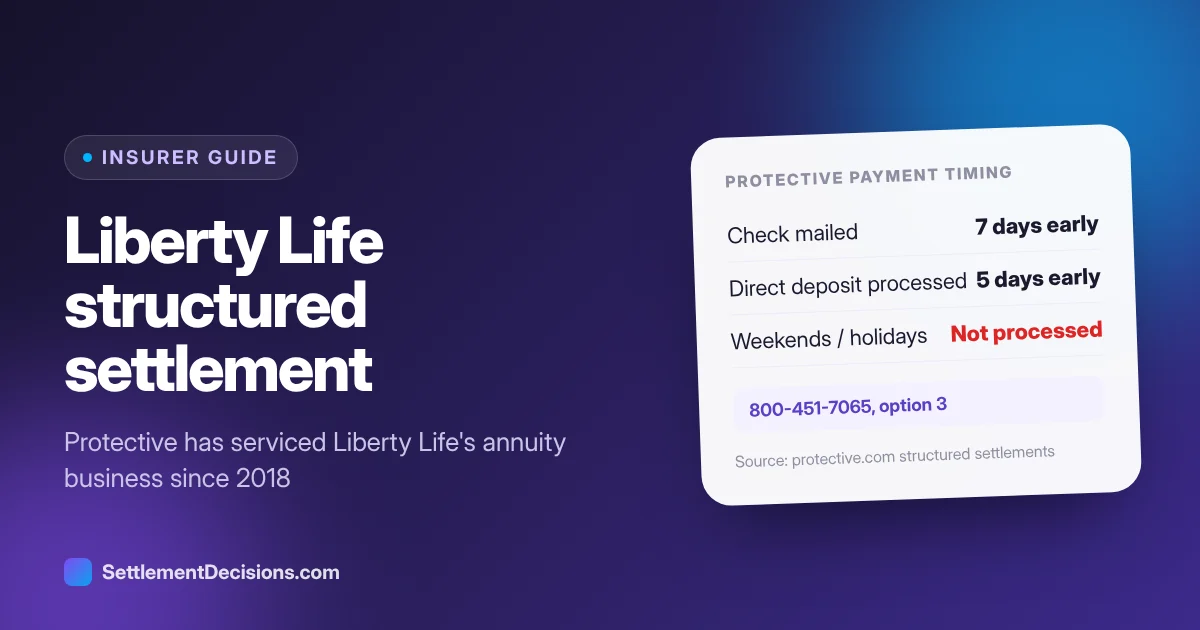
| Check | Mailed seven days before the due date in your settlement |
| Direct deposit (EFT) | Processed five days before the due date. The money is available that day or the next. |
Protective doesn't process payments on weekends or holidays. It also warns that the payer name on your bank statement will change, and you don't need to do anything about that. If a payment is late, see what to do about a late or missing payment.
Can you sell Liberty Life structured settlement payments?
Protective's pages don't mention selling, and Protective doesn't offer to cash out your payments. A lump sum means selling some or all future payments to a third-party buyer, and that needs court approval.
Liberty Life had a history of fighting sales in court before today's rules were in place:
| Case | What happened |
|---|---|
| In re Shaffer (Ill. App. Ct., Mar. 14, 2001) | A payee tried to sell two future payments to Singer Asset Finance. Liberty Life and Keyport stepped in. The appeals court enforced the settlement's anti-assignment clause and upheld the trial court's reversal of its earlier approval. |
| Liberty Life Assurance Co. of Boston v. Stone Street Capital (U.S. District Court) | A payee with $1,000 a month for life assigned his payments to Stone Street. The court called the assignment "invalid and wholly void" and said the consent judgment didn't bind Liberty Life or Keyport. |
The rules are different now. In 2002, Congress added a 40% excise tax on buyers in 26 U.S.C. § 5891 for any sale without a qualified court order. Most states now have a structured settlement protection act. Under those laws, a judge decides whether the sale is in your best interest, and the insurer and payer get notice. Legitimate buyers file in court. If someone offers to pay you without a court hearing, walk away. See what judges ask at the hearing and why courts deny transfers.
If you're thinking about selling
- Confirm who holds your contract. Call Protective with your policy number and ask for a letter that lists your remaining payments. Buyers price from it.
- Sell only what you need. A partial sale of some payments often costs less than selling everything.
- Get at least three written offers for the same payments. Compare net cash and the effective annual rate. Our discount rate calculator finds the rate in any offer, and the court deal benchmark shows rates in real approved deals.
- Check the buyer's registration where your state requires it: registered buyers by state.
- Get independent advice. Many states require it, and judges ask about it.
Talk to a qualified financial advisor before you sign anything.