

Why malpractice cases end up as structured settlements
Medical malpractice cases involve some of the largest future-damages claims in personal injury law: decades of care, lost earnings and therapy. Several states respond by moving those future damages into periodic payments rather than one lump sum. Even when the law doesn't require it, settling parties often choose a structure so the money lasts as long as the need does.
That has two effects for anyone thinking about selling. First, many malpractice recipients have larger and longer payment streams than in other injury cases. Second, judges are especially careful about sales, because the payments often fund medical care the person will need for life.
California: CCP § 667.7
California's Code of Civil Procedure § 667.7 applies to lawsuits against health care providers. As amended by the MICRA reforms that took effect in 2023, if the award equals or exceeds $250,000 in future damages, the court must, at the request of either party, enter a judgment ordering those future damages paid in whole or in part by periodic payments rather than a lump sum. (Before the reform, the threshold was $50,000.)
Other features of the statute:
- A defendant that isn't adequately insured must post security to guarantee the payments.
- The judgment can be modified only if the claimant dies.
- Damages for lost future earnings don't end at death. They continue to the people the claimant was supporting.
Payments under a section 667.7 judgment are different from a negotiated settlement. Many California malpractice cases settle with a structured settlement funded by an annuity. Those settlement payments can generally be sold under California's structured settlement protection law with court approval. Payments ordered directly by a periodic-payment judgment may raise different issues, so get advice from an attorney before you try to sell them. See selling a structured settlement in California.
New York: CPLR 5031
New York's CPLR 5031 sets out how future damages in medical, dental and podiatric malpractice judgments are paid:
| Type of damages | How it's paid |
|---|---|
| Past damages, and future pain and suffering of $500,000 or less | Lump sum |
| Future pain and suffering above $500,000 | Lump sum of the greater of 35% or $500,000; the rest paid over the shorter of the period set by the jury or 8 years, rising 4% a year |
| Future economic damages (medical care, lost earnings and similar) | 35% of the present value as a lump sum; the remaining 65% through an annuity in monthly installments |
The present value of these streams is calculated using the 10-year U.S. Treasury rate, with a higher rate for years beyond 20. Lost-earnings payments run for the full period awarded, and payments for permanent economic losses continue for the claimant's lifetime.
These statutory annuities follow a judgment. Settlements in New York malpractice cases are often structured by agreement too. Either way, the first step is to read the documents and see exactly what you own. For New York procedure, see our state laws and court approval guide.
What medical malpractice payments are worth
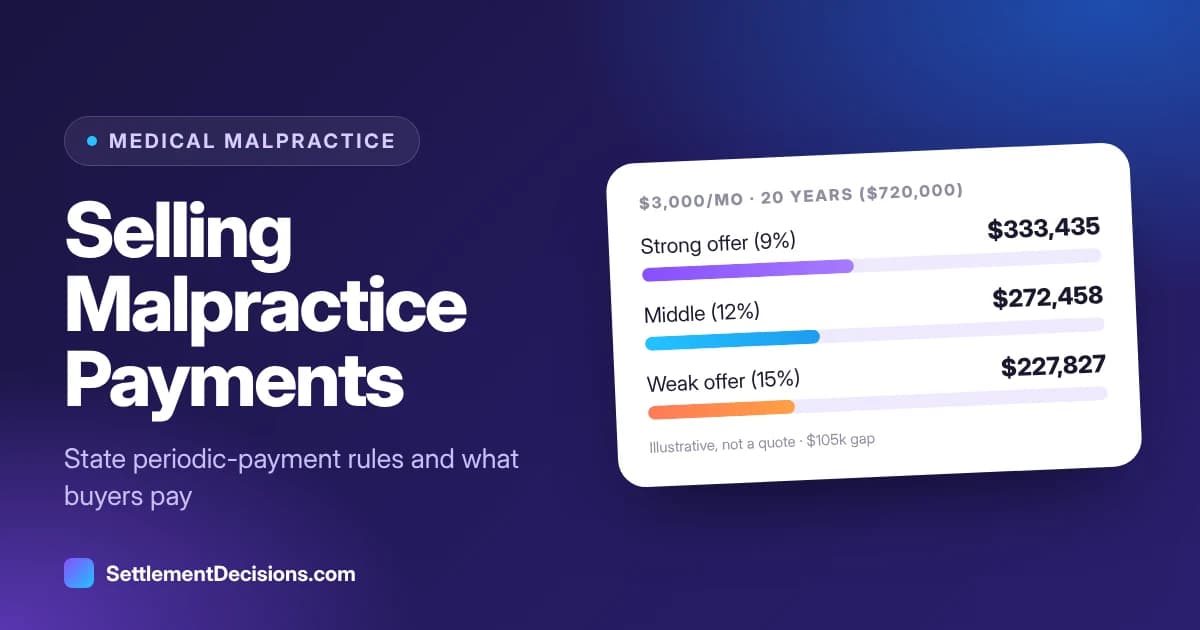
Buyers discount future payments back to today. Here are two typical malpractice-size streams at illustrative strong (9%), middle (12%) and weak (15%) discount rates. These are not quotes.
| Payments | Total | At 9% | At 12% | At 15% |
|---|---|---|---|---|
| $3,000/month for 20 years | $720,000 | $333,435 | $272,458 | $227,827 |
| $2,500/month for 15 years | $450,000 | $246,484 | $208,304 | $178,624 |
| $250,000 lump sum due in 15 years | $250,000 | $68,635 | $45,674 | $30,724 |
On long streams, the gap between offers is very large. For $3,000 a month over 20 years, a 9% offer beats a 15% offer by more than $105,000. That's why getting several written quotes matters more in malpractice cases than almost anywhere else.
You can price your own payments with the payout calculator or compare a range of offers in the instant offer estimator.
Rule of thumb: On a stream longer than 15 years, every percentage point of discount rate is worth thousands of dollars. Never accept the first quote, and ask each buyer for the effective annual rate in writing.
Taxes
Damages received for personal physical injuries or physical sickness are generally excluded from income under 26 U.S.C. § 104(a)(2). Most malpractice settlements fall into that category, so the payments are usually tax-free. Most tax professionals treat the lump sum from a court-approved sale the same way.
Exceptions include punitive damages and interest. A sale without a court's qualified order exposes the buyer to a 40% excise tax under 26 U.S.C. § 5891, which is one more reason the court step can't be skipped. Read our tax guide for selling and talk to a tax professional.
What judges look at in malpractice sales
All state protection acts require the court to find that a sale is in the payee's best interest. In malpractice cases, expect the judge to ask:
- How will future medical care be paid for? If the payments were meant for care, the court will want to see that care is still covered, by insurance, a trust or the payments you're keeping.
- Is there a guardian or conservator? Many malpractice recipients are children or adults with disabilities. A sale may need the guardian's involvement or a separate court's approval.
- Are there public benefits at stake? A lump sum can affect eligibility for means-tested programs such as SSI or Medicaid. Some recipients use a special needs trust. Get advice before you sell.
- Is the price fair? The disclosure statement shows the discount rate, and judges compare it with what's reasonable.
- Did you get independent advice? Some states require it. See independent professional advice.
Our list of questions the judge asks will help you prepare.
Partial sales: the usual best fit
Because malpractice payments so often fund ongoing care, selling everything rarely makes sense. Common partial options:
- Sell a fixed number of payments, for example the next three or five years, and keep the rest.
- Sell part of each payment, such as $1,000 of a $3,000 monthly payment, leaving $2,000 coming in.
- Sell a future lump sum you don't need for care, such as a payment scheduled at age 40.
A partial sale lets you solve the immediate problem, such as home modifications, a wheelchair-accessible vehicle or debt from treatment, without giving up the income stream that supports long-term care.
A worked example
Suppose you receive $3,000 a month for 20 years and need about $45,000 to adapt your home. Rather than selling the whole stream, you sell $1,000 of each monthly payment for the next five years, 60 payments of $1,000.
At illustrative discount rates, that partial sale brings about $48,200 at 9%, $45,000 at 12% and $42,000 at 15%. You keep $2,000 a month for those five years, then the full $3,000 a month for the remaining 15 years. Selling the entire stream at 12% would bring about $272,500 but leave you with nothing coming in.
How to sell, step by step
- Gather your documents: the settlement agreement or judgment, the annuity contract and any guardianship orders.
- Decide how much you need and which payments to sell.
- Get at least three written offers for the same payments, with discount rates.
- Check each buyer: registration where your state requires it, BBB history and court records. See registered buyers by state.
- Sign with your chosen buyer after reviewing the disclosure statement.
- Attend the hearing and explain your plan, especially how care will be paid for.
- Get funded once the order is signed and the annuity issuer acknowledges it.
Bottom line
Medical malpractice structured settlements can usually be sold, but they're often the backbone of someone's lifelong care, and the long payment streams make the discount rate unusually important. Understand what you own, whether it comes from a settlement or a periodic-payment judgment, sell only what you need, compare at least three written offers, and talk to a qualified financial advisor and an attorney who is independent of the buyer before your hearing.