

How car accident structured settlements work
When a car accident causes serious injuries, the at-fault driver's insurer often settles part of the claim with a structured settlement: a stream of guaranteed payments instead of one check. It's especially common when the injured person is a minor, when future medical costs are large, or when the settlement is big enough that a lifetime income makes sense.
Behind the scenes, the insurer usually transfers its obligation to a separate company through a qualified assignment under Internal Revenue Code § 130. That company buys an annuity from a life insurer, which then makes your payments. Your settlement agreement spells out the amounts and dates, for example $1,000 a month for 10 years, or lump sums at ages 18, 21 and 25.
Those payments are yours, and they can be sold. But because they come from a court case and are meant to protect you, the sale has to go through a judge.
Can you sell car accident settlement payments?
Yes, in every state. Each state has a structured settlement protection act that lets you transfer future payments to a buyer if a court approves. The federal tax code backs this up: under 26 U.S.C. § 5891, a buyer that acquires payment rights without a court's qualified order owes a 40% excise tax on the discount. That's why no legitimate buyer will skip the court step.
To approve a sale, a judge typically has to find that:
- the transfer is in your best interest, taking into account the welfare and support of your dependents,
- you received a written disclosure showing the total payments, the price, the present value and the effective discount rate,
- you were advised to get, or in some states actually got, independent professional advice, and
- the sale doesn't violate any court order or the terms of your settlement.
See what the judge asks at the hearing to prepare.
What your payments are worth
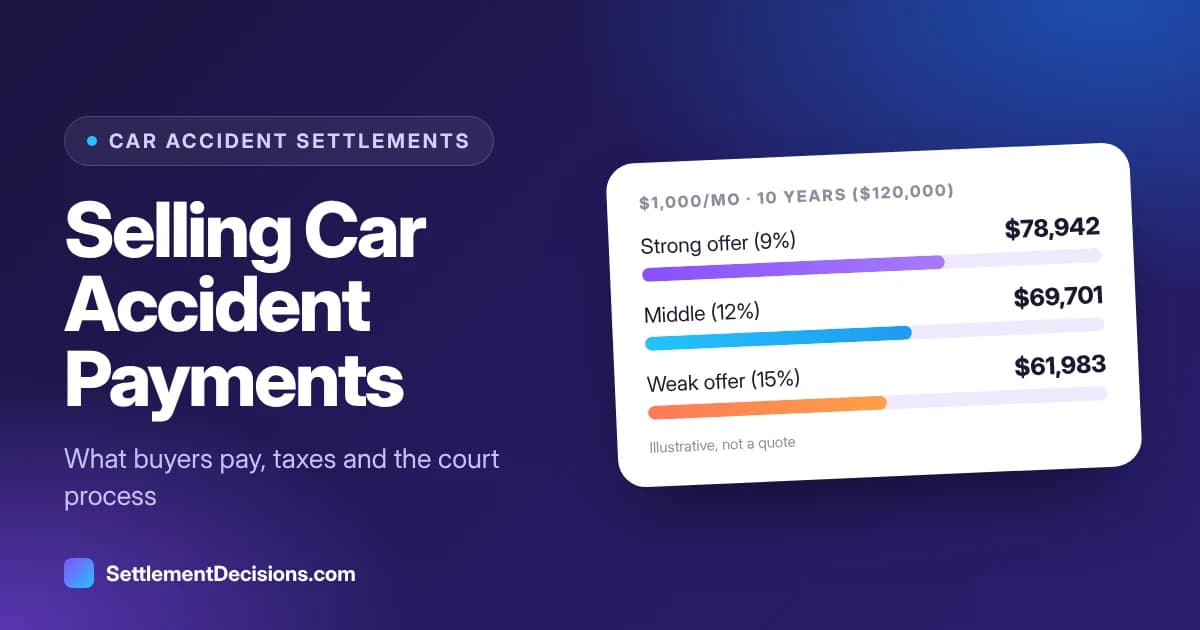
Buyers price future payments by discounting them back to today. The higher the discount rate, the less cash you get. These tables use illustrative rates for strong (9%), middle (12%) and weak (15%) offers. They are not quotes.
Monthly payments
| Payments you sell | Total | At 9% | At 12% | At 15% |
|---|---|---|---|---|
| $1,000/month for 10 years | $120,000 | $78,942 | $69,701 | $61,983 |
| $1,500/month for 10 years | $180,000 | $118,413 | $104,551 | $92,974 |
| $1,000/month for the next 5 years only | $60,000 | $48,173 | $44,955 | $42,035 |
Future lump sums
| Payment | At 9% | At 12% | At 15% |
|---|---|---|---|
| $50,000 due in 5 years | $32,497 | $28,371 | $24,859 |
| $100,000 due in 10 years | $42,241 | $32,197 | $24,718 |
Two patterns stand out. The farther away a payment is, the less it's worth today, and the bigger the gap between a strong and a weak offer. On $100,000 due in 10 years, the difference between 9% and 15% is more than $17,000.
Run your own payments in the payout calculator, or see a range of offers in the instant offer estimator.
Rule of thumb: Ask each buyer for the effective annual discount rate in writing. Comparing rates is the fastest way to see which offer is really better, even when the payments being bought differ slightly.
Taxes on a car accident settlement sale
For most car accident cases, the news is good:
- The payments are generally tax-free. Damages received on account of personal physical injuries or physical sickness are excluded from gross income under 26 U.S.C. § 104(a)(2), whether paid as a lump sum or periodic payments.
- The lump sum from a sale is usually treated the same way. Most tax professionals treat cash from selling tax-free injury payments as tax-free too, although the IRS hasn't issued detailed guidance on the seller's side, so confirm with your own adviser.
- Exceptions exist. Punitive damages, interest, and parts of a settlement for non-physical claims such as pure emotional distress can be taxable. Property damage reimbursements for the car itself are a separate matter.
Check your settlement agreement and talk to a tax professional before you sell. Our tax guide to selling structured settlements goes deeper.
The court process, step by step
- Collect your documents: the settlement agreement, the annuity contract or benefit letter, and any court order that created the structure.
- Get quotes from at least three buyers for the same payments.
- Sign a purchase agreement with your chosen buyer and receive the disclosure statement. Many states require a waiting period between disclosure and signing.
- The buyer files a petition in your county court. The annuity issuer and other interested parties get notice.
- Attend the hearing. Be ready to explain why you need the money and how you'll use it. Judges look closely at hardship and planning.
- Funding. After the judge signs the order and the annuity issuer acknowledges it, the buyer pays you. Most deals take roughly 45 to 90 days, largely because of the court calendar.
If the judge says no, you can usually fix the problem and try again. See what to do if court approval is denied.
Special situations in car accident cases
- The injured person was a minor. Payments set up for a child often start at 18. Courts are especially careful with young sellers, so expect detailed questions. See our guide to structured settlements for minors.
- The accident happened at work. If you were driving for your job, your payments may come from a workers' compensation settlement, which has its own rules. See selling workers' comp structured settlements.
- There's a lien or child support order. Medical liens are usually settled before the structure is set up, but child support, tax levies or bankruptcy can affect a sale. See selling with liens, child support or bankruptcy.
- The payments are life-contingent. If payments stop at death, buyers often require life insurance or charge a higher rate. See life-contingent payments.
When selling makes sense, and when it doesn't
Selling can make sense when the cash solves something the monthly payments can't: making a home accessible after an injury, paying for a vehicle adapted to a disability, clearing high-interest debt, or covering medical care that insurance won't.
It usually doesn't make sense when the payments cover your basic living costs, when the reason is a want rather than a need, or when the lump sum would simply sit in a bank. Remember that the settlement was structured for a reason, often to fund care you'll need for years.
A partial sale is often the best of both. Selling only the next five years of a $1,000-a-month stream, for example, brings roughly $42,000 to $48,000 and leaves every payment after that untouched.
Common mistakes to avoid
- Selling everything when you need part. Most buyers will quote a partial sale. Ask for both and compare.
- Accepting the first offer. On the same payments, offers at 9% and 15% can be more than $16,000 apart. Get at least three.
- Taking an advance before the hearing. It can tie you to one buyer. Read about advances before court approval first.
- Not reading the disclosure statement. It shows the effective discount rate. If it doesn't match what you were told, ask why before the hearing.
- Going to the hearing unprepared. Bring a simple written plan for the money: what it pays for, what it costs and how you'll cover your expenses afterward.
- Ignoring dependents. If anyone relies on you financially, the judge will ask how the sale affects them. Have an answer.
Bottom line
Car accident structured settlement payments can be sold, they're usually tax-free, and a judge has to agree that the sale is in your best interest. The price depends almost entirely on the discount rate, so get at least three written offers, compare rates and net cash, and sell only what you need. Before your hearing, talk with a qualified financial advisor and, if your settlement is complex, an attorney who is independent of the buyer.