

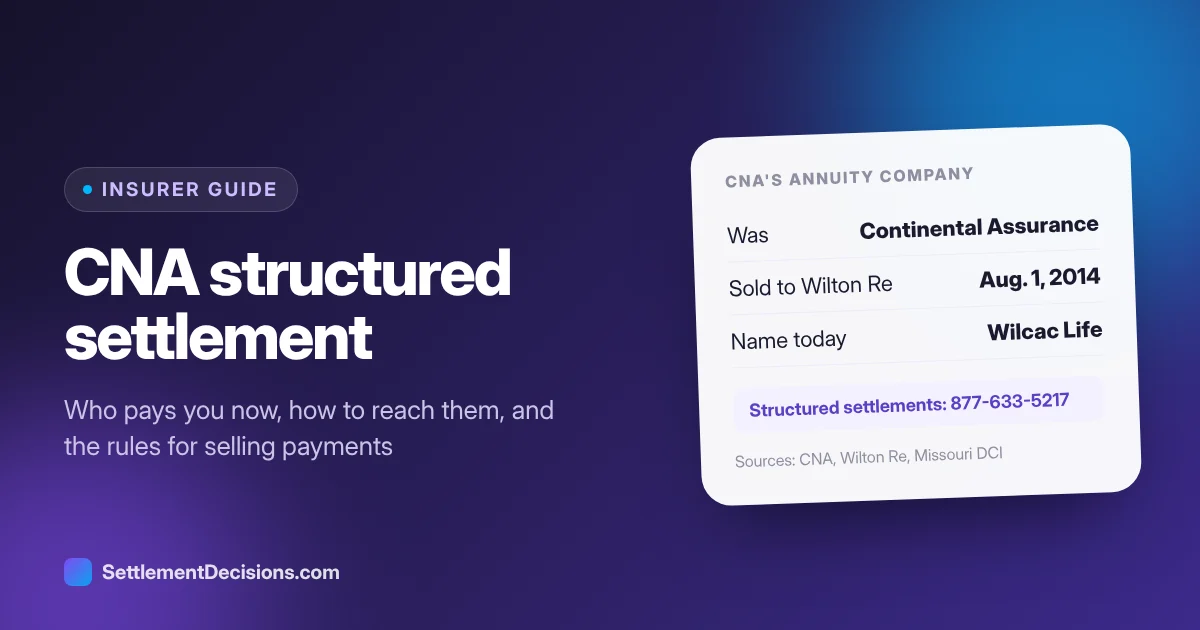
Why your CNA payments now come from Wilton Re
CNA is a property and casualty insurer. When it settled injury claims with a structured settlement, the monthly payments were usually funded by an annuity from its own life company, Continental Assurance Company (often shortened to "CAC" on paperwork). A typical setup looked like the one in a 2003 New York court decision: the claim was settled by a CNA company, the payment duty was assigned to CNA Structured Settlements, Inc., and that assignee bought a funding annuity from Continental Assurance Company, which then made the monthly payments.
Here's what happened to that annuity company:
| Date | Event | Source |
|---|---|---|
| Feb. 10, 2014 | CNA announces the sale of Continental Assurance Company to Wilton Re. CNA describes CAC as a life subsidiary "consisting primarily of structured settlement and group annuities." | CNA press release |
| Aug. 1, 2014 | The sale closes. Wilton Re says it acquired about $2.5 billion of statutory reserves. | CNA and Wilton Re releases |
| Aug. 1, 2014 | A.M. Best upgrades CAC's financial strength rating to A (Excellent) from A-, citing Wilton Re's ability to support it. | Wilton Re release |
| 2015 | Continental Assurance Company changes its name to Wilcac Life Insurance Company. Missouri's insurance department lists the change as effective March 31, 2015. | Missouri DCI; West Virginia business registry |
| Dec. 31, 2020 | Wilco Life Insurance Company, another Wilton Re company, merges into Wilcac. | Arizona DIFI order; Missouri DCI |
The sale changed who owns the insurer, not your contract. Your payment amounts and dates stay the same. Wilcac Life Insurance Company is an Illinois company (NAIC 62413), and Missouri's regulator lists its license as active.
A second, smaller piece of the 2014 deal: a Wilton Re subsidiary agreed to reinsure "all of the run-off structured settlement annuities" that a Bermuda-based CNA subsidiary had reinsured. Reinsurance happens between insurers behind the scenes; it doesn't change who sends your check.
Does CNA still owe any structured settlements?
Some, yes. CNA said the 2014 deal disposed of "the vast majority" of its payout annuity business, not all of it. CNA's 2025 annual report also says it discounts its reserves for structured settlements that aren't tied to asbestos and pollution claims, which means CNA's insurance companies still carry some structured settlement obligations on their own books.
So check your settlement agreement and your check stubs:
- Checks from Wilcac Life, Wilton Re, or the old Continental Assurance Company: the annuity is with Wilcac. Use the Wilton Re numbers below.
- Checks directly from a CNA property-casualty company (for example, Continental Casualty Company): the payments may be owed by CNA itself without an annuity. Ask CNA's claims office which company owes you.
Our guide to owner, payee and beneficiary roles explains who controls what in a structured settlement.
How to contact Wilton Re about CNA payments
Wilton Re's "For Policyholders" page lists these lines for Wilcac Life Insurance Company, formerly Continental Assurance Company:
| What you have | Phone |
|---|---|
| Structured settlement payments | 877-633-5217 |
| Annuity or group annuity contracts that start with "CAC" | 800-304-3454 |
| Term life, universal life, deferred or payout annuities | 866-880-3112 |
| Pensions | 800-351-3001 |
Wilton Re's corporate office is at 801 Main Avenue, 5th Floor, Norwalk, CT 06851 (203-762-4400). That's the head office, not the service line, so start with the structured settlement number.
Have your contract number and settlement date ready. If your paperwork still says CNA or Continental Assurance, use it anyway. Lost the documents? See how to find lost settlement paperwork. If a payment is late, see what to do about a late or missing payment.
Is Wilcac Life financially safe?
The last rating we could confirm from a primary source is A.M. Best's August 1, 2014 upgrade to A (Excellent). We couldn't verify a current rating, so ask Wilton Re or check A.M. Best directly. Ratings measure claims-paying ability; they aren't a guarantee. If an insurer ever failed, state life and health guaranty associations would step in up to set limits; see what happens if your insurer goes bankrupt.
Can you sell CNA structured settlement payments?
Yes, but not without a judge. Every sale of structured settlement payments needs a court order under your state's structured settlement protection act. Federal law puts a 40% excise tax on any buyer that acquires payments without a qualified order (26 U.S.C. § 5891), so legitimate buyers always go to court. Wilcac and the obligor get notice of the hearing, and after approval the sold payments are redirected to the buyer.
Here's a published example with this exact setup. In Matter of Settlement Funding of New York, LLC (Platt) (Sup Ct, Lewis County, Nov. 4, 2003), the payee's monthly payments were owed by CNA Structured Settlements, Inc. and funded by Continental Assurance Company. He sold about seven years of monthly payments plus 44 later, larger ones, $67,263.68 in total, for a gross advance of $23,600. After $2,200 in legal and processing fees, he received $21,400. The court said the deal used an annual discount rate of 19.99%, approved it as fair and reasonable, and added that "no blanket approval of the discount rate employed here is intended." That's one 2003 deal, not a benchmark for today. For recent approved deals, use our court deal benchmark.
Judges also turn deals down; see why courts deny structured settlement sales.
If you're thinking about selling
- Confirm who owes you. Call Wilton Re at 877-633-5217 (or CNA, if your checks come from a CNA company) and ask for a list of your remaining payments. Buyers price from that list.
- Sell only what you need. A partial sale of some payments often costs less than selling everything.
- Get at least three written offers for the same payments. Compare net cash after all fees and the effective annual rate. Our discount rate calculator finds the rate in any offer.
- Check the buyer's registration where your state requires it: registered buyers by state.
- Get independent professional advice. Many states require it, and judges ask about it.
Life-contingent payments are harder to sell and fetch less; see selling life-contingent payments. Talk to a qualified financial advisor before you sign anything.