

Which Mutual of Omaha companies are on your papers?
A structured settlement usually involves two companies, and Mutual of Omaha uses two affiliates. Mutual of Omaha's structured settlement page names both and says they are "affiliate companies of Mutual of Omaha Insurance Company," based at 3300 Mutual of Omaha Plaza, Omaha, Nebraska.
| Role | Company | What it does |
|---|---|---|
| Annuity issuer | United of Omaha Life Insurance Company ("United") | Issues the annuity that funds your payments. Mutual of Omaha's brochure says "periodic payment obligations are guaranteed by United of Omaha." |
| Assignee (the company that owes you) | Mutual of Omaha Structured Settlement Company ("MOSSCO") | Takes over the defendant's duty to pay you under a qualified assignment. Mutual of Omaha says MOSSCO "accepts full responsibility for all assigned contractual obligations." |
| Parent | Mutual of Omaha Insurance Company | Owns United. The brochure calls United "a wholly-owned subsidiary." |
Mutual of Omaha's page also says United "is authorized to do business in all states except New York." So if you live in New York, a Mutual of Omaha structured settlement is unlikely to have been issued to you there. Check the names on your settlement agreement and annuity contract. Our guide to owner, payee and beneficiary roles explains who controls what.
Not every case uses an assignment. Mutual of Omaha's broker forms list separate tax forms for "assigned" cases (MOSSCO) and "unassigned" cases (United). If your case wasn't assigned, the defendant or its insurer may still be the party that owes you, with United's annuity funding it.
What kinds of payments Mutual of Omaha offers
Mutual of Omaha's structured settlement page lists these payment options:
- Term certain: payments for a set period, whether you live or not.
- Life only: payments for your lifetime, ending at death.
- Certain and life: lifetime payments with a guaranteed minimum period.
- Joint and contingent survivor: payments continue to a second person at "a selected percentage of the benefit."
- Guaranteed lump sums: scheduled one-time payments.
Its brochure adds that "cost-of-living adjustments are available." Your own payment schedule is in your settlement agreement, so check that rather than the menu above. Life-contingent payments are harder and cheaper to sell; see selling life-contingent payments.
How to contact Mutual of Omaha about your payments
From Mutual of Omaha's structured settlement page and its post-contract service forms page:
| What you need | How |
|---|---|
| Phone (benefit services) | 800-843-2455 (the service forms page points post-contract questions to option 3) |
| Hours | Monday to Friday, 7:00 a.m. to 4:30 p.m. Central |
| structuredsettlements@mutualofomaha.com (benefit services) or structuredservice@mutualofomaha.com (service forms) | |
| Fax | 402-997-1900 |
Have your contract number ready when you call. If you've lost your paperwork, see how to find lost settlement documents.
Forms for common changes
Mutual of Omaha's service forms page lists these forms:
| Change | Form | Notes from Mutual of Omaha |
|---|---|---|
| Address or name | RPD994 | "Return a completed and signed form to United of Omaha." |
| Direct deposit | RPD979 (EFT agreement) | Direct deposit is described as a "free service." An electronic copy of the form is accepted. |
| Beneficiary | RPD1030 | Only "if permitted by the settlement agreement." Many settlement agreements limit beneficiary changes; see changing a structured settlement beneficiary. |
The benefit services team also lists copies of your annuity contract and income verification letters sent to third parties at your request. Lenders and landlords often ask for one; see structured settlement income verification letters.
How strong is United of Omaha?
Mutual of Omaha's structured settlement brochure (form 80282, ratings "as of July 2025") lists:
| Agency | Rating | Brochure's description |
|---|---|---|
| AM Best | A+ (Superior) | second highest of 16 |
| S&P Global | A+ (Strong) | fifth highest of 21 |
| Moody's | A1 (Good) | fifth highest of 21 |
Ratings change, so check the agencies' current ratings if this matters to your decision. Ratings measure claims-paying ability; they don't guarantee anything. If an insurer ever fails, state guaranty associations step in up to set limits; see what happens if your insurance company goes bankrupt.
Can you sell Mutual of Omaha structured settlement payments?
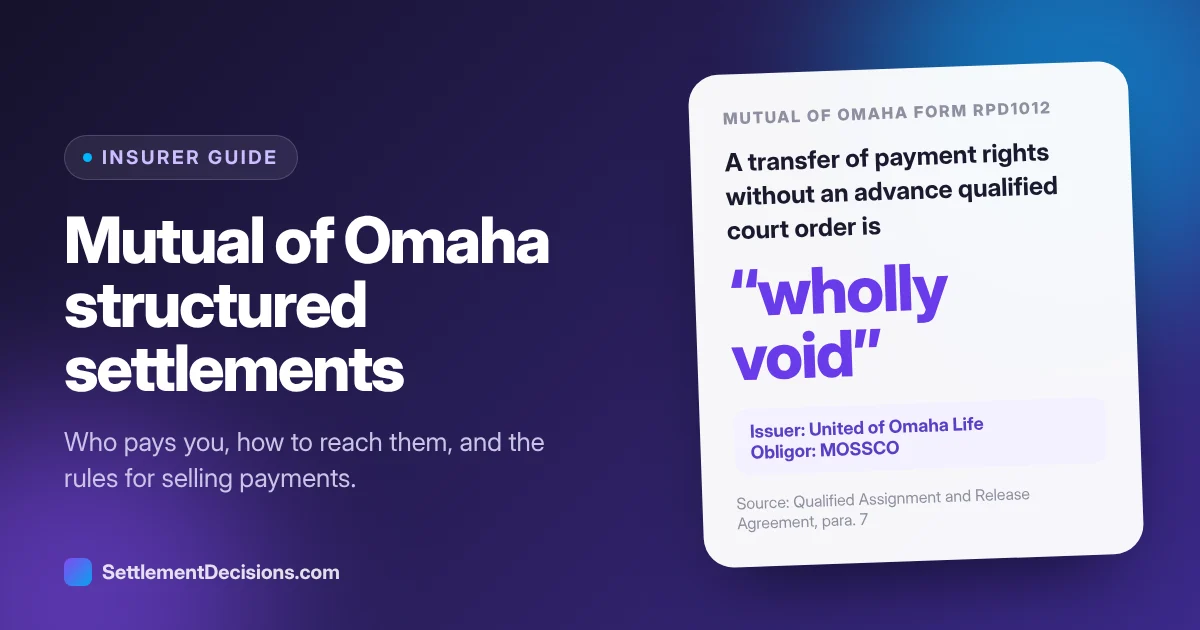
Yes, but not freely. Mutual of Omaha's own qualified assignment form (RPD1012) says your payments cannot be "sold, assigned, pledged, hypothecated or otherwise transferred or encumbered" unless the transfer is approved in advance in a qualified order under Internal Revenue Code section 5891(b)(2) and complies with state law, "including without limitation any applicable state structured settlement protection statute." Any other transfer "shall be wholly void."
In practice that means:
- A judge must approve the sale first. Nearly every state has a structured settlement protection act, and the court usually sits in the state where you live. The judge must find the sale is in your best interest. See how court approval works.
- The buyer pays a heavy tax if it skips court. Federal law imposes a 40% excise tax on a buyer that acquires payments without a qualified order (26 U.S.C. § 5891). That's why legitimate buyers always go to court.
- United and MOSSCO are notified. State laws require notice to the annuity issuer and the obligor, and after approval they redirect the sold payments to the buyer.
- Mutual of Omaha doesn't buy your payments. The offer comes from a third-party buyer. Its discount sets how much cash you get.
Judges do turn deals down. See why courts deny structured settlement sales.
If you're thinking about selling
- Confirm who owes you. Call 800-843-2455 and ask which company (MOSSCO or another party) is the obligor, and for a list of your remaining payments. Buyers price from it.
- Sell only what you need. A partial sale of some payments often costs less than selling everything.
- Get at least three written offers for the same payments. Compare net cash and the effective annual rate. Our discount rate calculator finds the rate in any offer, and the court deal benchmark shows rates in real court-approved deals.
- Check the buyer's registration where your state requires it: registered buyers by state.
- Get independent advice. Many states require it, and judges ask about it.
Talk to a qualified financial advisor before you sign anything.